On UNESCO World Cities Day 2025, Kashan was recognized by UNESCO as a “creative city of architecture,” joining cities like Rome, Paris, and Barcelona. Kashan was “celebrated for its sustainable architecture and rich civilizational heritage.” But Kashan is renowned in history not just for Iranian-Islamic architecture, but also for Islamic art, magnificent silk and cotton woven carpets, and ceramics (Kashan ware). Survey of an ancient and thriving Iranian jewel, accompanied by videos, photos, and links for further readings.
Introduction
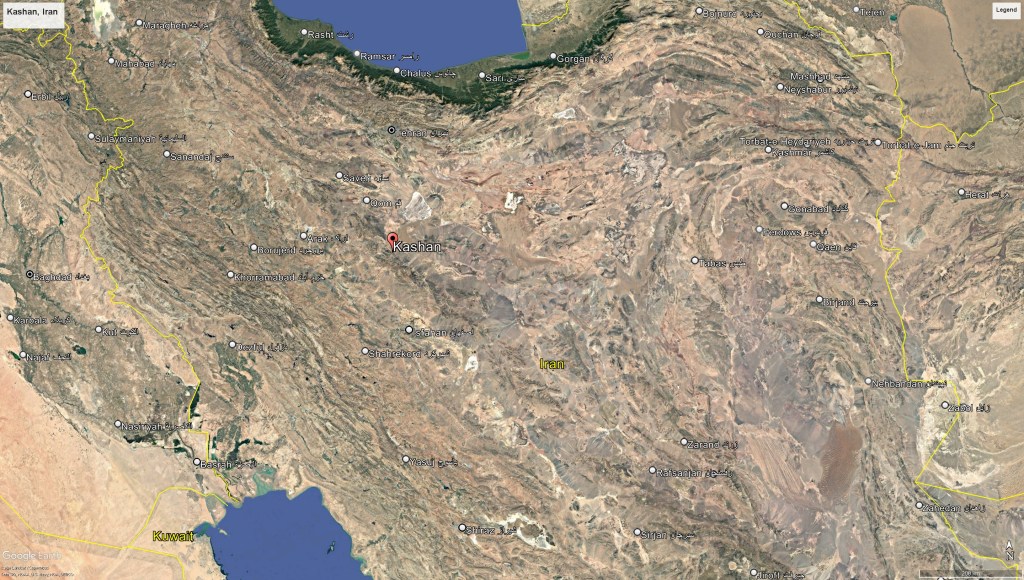
Kashan (33° 59ʹ 30ʹʹ N, 51° 27ʹ 00ʹʹ E; elev. 950m) is ca. 260km south of Tehran (see map). It is an ancient city, as attested by fifth millennia BC ruins, with life continuing to be recorded in the vicinity to the first millennium BC. Kashan’s efflorescence began in the Islamic era. Encyclopaedia Iranica (EI; throughout), explicates Kashan’s and greater Kashan’s “History to the Pahlavi Period” (i.e., to the Iranian Revolution), with entries for the region’s geography and historical geography.
Kashan is best known for its architecture. It boasts about 1,700 historical monuments, of which 330 are registered national heritage sites. EI covers Kashan’s architectural heritages under the rubrics “urban design,” historical monuments,” “traditional architecture,” and “historic mansions,” but EI’s articles offer very few images and schematics. Fortunately, there are manifold images online, for e.g., Google, DuckDuckGo, Travel Around Persia; and Pexels.com (copyright free download is possible). Although predominantly a Muslim city, Kashan has a vibrant Jewish community. Iranian Jews are indisputably the oldest Jewish community in the Middle East, having continuously lived in Iran for millennia.

Cultural Influence
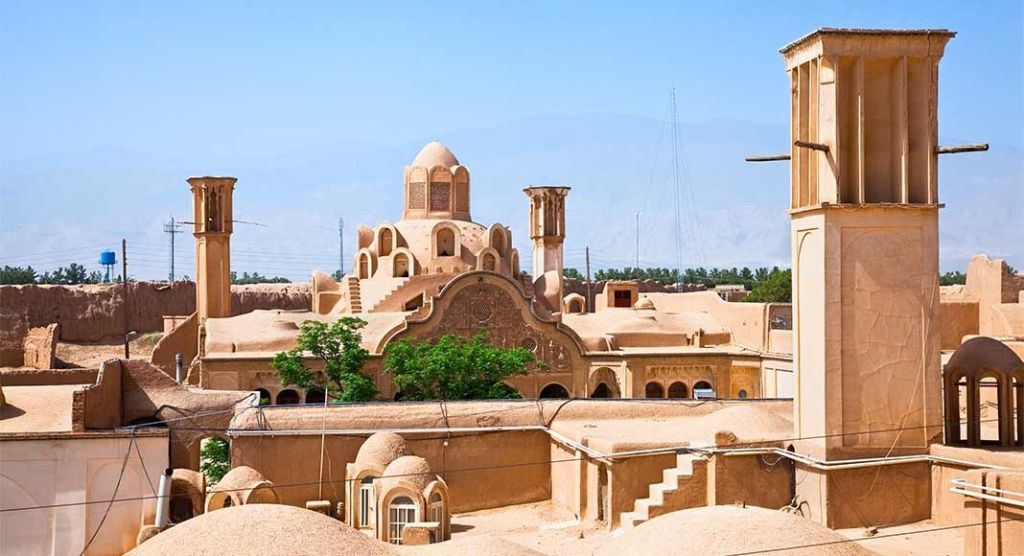
Kashan’s influence on culture extends beyond Iran. Firstly, most of Kashan’s architectural designs are not solely for aesthetic, spiritual, or commercial purposes; they are designed to accommodate the region’s harsh climate, where temperatures can range from freezing in winter, to 50°C in summer. Kashan’s windcatchers (badgir) and domed structures, serve to cool interiors. Subterranean aqueducts (kariz, qanat) disgorge in cisterns inside buildings, cooling air inducted by windcatchers. These ancient architectural features of Kashan and Yazd find favor with contemporary architects designing ecologically sustainable buildings. Iranian engineering concepts proliferate in modern structures in Persian Gulf states.
Second, the unique design of the “The Persian Garden”—not any specific garden—is one of Iran’s 29 UNESCO World Heritage Sites. The Persian Garden has origins in the Achaemenid period (first millennium B.C.). Its influence is found in gardens in Granada, Cordoba, and India. Kashan boasts one Persian Garden, Bagh-i fin (Fin Garden; 6km SW of city center).
Thirdly, Kashan’s cultural outputs include ceramics (“Kashan ware”) and carpets. Kashan is famous for varieties of cotton and silk carpets, particularly Gelim (Kelim in Turkish), a type of woven carpet.
Last Word
The four aspects above (ecologically-friendly architecture, Persian Gardens, Kashan ware, and carpets) are not the only contributions by Kashan to Iranian and global culture. I just wanted to highlight a few features.
Kashan had many roles in historical and religious developments over millennia, but one tangential connection is noted. The Gospel of St. Matthew states, “After Jesus was born in Bethlehem in Judea, during the time of King Herod, Magi from the east came to Jerusalem [and said] We saw his star when it rose and have come to worship him” (Matthew (2:1–2). Lore claims the Magi—Persian for Zoroastrian priest—came from Kashan. It is popularly believed, however, the Magi had traveled from Ctesiphon (eastern Iraq; part of Iran until 1639, when Iran’s Safavid dynasts lost Iraq to the Ottomans). Adding to lore is the existence of a Zoroastrian center of faith and science in Saveh (180km NW of Kashan). When Marco Polo (d. 1324) visited Saveh, locals said Saveh is the town “from which the three Magi set out when they came to worship Jesus Christ. Here, too, they lie buried in three sepulchres of great size and beauty…” Saveh, Kashan, or Iranian Iraq, Magi were assuredly Iranian. They are depicted in Iranian dress in a Byzantine work of art from ca. 565.

Yazd is my favorite Iranian city, but Kashan is second. Kashan is an essential stop on a tour of Iran. The cuisine has local variants worth trying: aubergine (eggplant to Yanks) dishes; meatballs (kufta); and dizi pilaf (beef stew with beans and rice).
 Perspectives
You must be logged in to post a comment.