A primer on why Iran insisted on Oman as venue for talks. U.S. sought UAE—its vassal state—as venue for the Araghchi-Witkoff indirect meetings, but Iran held firm.
Religion and Ethnicity
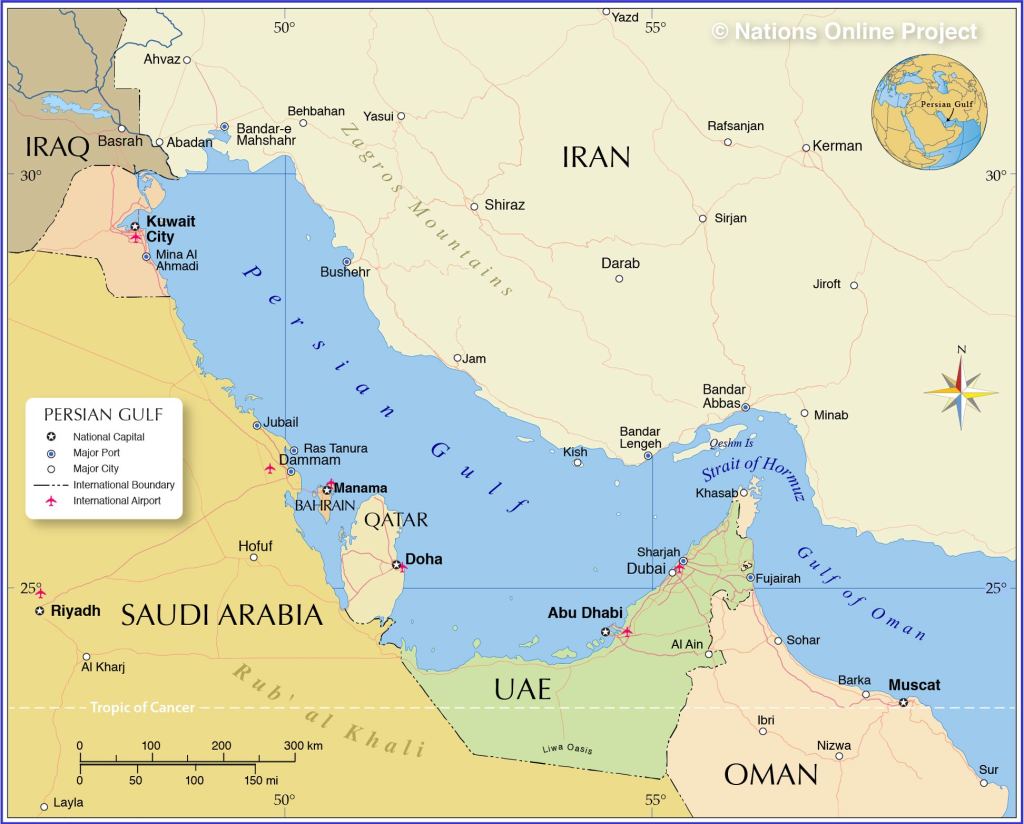
About 25% of Omani subjects are Baluchi, with ties to Iran’s Baluchi community located just across the Gulf of Oman. The balance of Oman’s population—not counting foreign workers—has origins in Oman, Sindh, Iran, and Zanzibar. Omanis are Muslim, but predominantly of the Ibadi sect[1], with a mix of Sunni and Twelver Shia (the dominant Shia sect in Iran). The Ibadi faith straddles Sunni and Shia communities in law and beliefs.
The Sultanate does not disfavor Shia beliefs, but vehemently opposes Wahhabism—the sect dominant in Saudi Arabia, Bahrain (leadership; the majority of the population is Twelver Shia); UAE, and Qatar; and the ideology of al-Qaida, ISIS, and Israel’s new BFF, al-Jawlani of Syria.
Iran-Oman Relations
Sultan Qaboos (r. 1970–2020; d. 10 Jan 2020) established cordial ties with Iran following the coup that brought him to power. The Shah of Iran—and King Husein of Jordan and the Brits—helped Qaboos quash a communist insurgency originating in the Yemen (Dhofar rebellion, 1962–76). During the Imposed War (Iran-Iraq War, 1980–88), Oman, although wary of the new Iranian leadership, did not go all in with Saddam Husein unlike the other Gulf Arab states (long story, but Qaboos had planned to allow Iraqi jets to strike Iran from Omani soil but decided against it).[2] He later tried to negotiate a settlement of the Imposed War.

Diplomatic Bridge
Oman has for decades been a “diplomatic bridge” between Iran and neighboring states; for example, the “China brokered” Iran-KSA rapprochement of 2023 was the fruit of two years of efforts by Iraq and Oman. China provided the diplomatic “heft” necessary to conclude the agreement.
Oman facilitated talks between the U.S. and Iran that led to the JCPOA. It has long been a “back channel” through which Iran and U.S. communicate.

Indirect Talks
Iran insists on indirect talks because the U.S. (viz., Trump) has threatened Iran and does not treat Iran with respect. Iran is a proud and nationalistic nation with thousands of years of history and culture. Iranian nationalism is why Israel seeks to topple the regime and install its lapdog-in-waiting, Reza Pahlavi. New countries, like USA, do not appreciate the extent of Iranian pride at its ancient history, language, and culture.
Indirect talks is when both delegations are in separate rooms with the Omanis shuttling back-and-forth with messages. Hence the imperative for a reliable intermediary. If Witkoff and Trump treat Iran with respect and courtesy, direct talks will be held.
Security
Oman guarantees physical security for all parties, but more importantly, talks in Muscat minimize the risks of electronic surveillance by enemy states (UAE, Israel, KSA, and USA). At Yalta, Stalin had the residences of the British and American bugged, allowing him to read their cards. Iranian security services will sweep rooms for devices, but it helps ease minds in Tehran that Omani security services are not in cahoots with Mossad (cf. UAE, Washington’s preferred venue for talks).
[1] See T. Lewicki, “al-Ibadiyya,” The Encyclopaedia of Islam, 2d ed., vol. III, pp. 648–660; Julius Wellhausen, The Religio-Political Factions in Early Islam, ed. R.C. Ostle, trs. R.C. Ostle and S.M. Walzer (Amsterdam and Oxford, 1975), pp. 1–91 (translation of Julius Wellhausen, Die religiös-politischen Oppositionsparteien im alten Islam, Berlin, 1901).
[2] It is fortuitous that Qaboos decided against allowing Iraqis to bomb Bandar Abbas from Omani soil because Iranians being Iranians, will have harbored this grudge for the next 5,000 years!
 Perspectives
You must be logged in to post a comment.