Introduction to this Series
We shall make him climb the town walls, which are as high as mountains, until the nails of his ten fingers are worn away […]. We shall make him climb the town walls, which are made of hard-pounded earth
Secret History of the Mongols, § 276
Chinese, Iranians, and Arabs did not enjoy being invaded by Inner Asian/Central Asian hordes: Seljuq Turks, Chingiz Khan’s Mongols, and Turco-Mongols led by Tamerlane. They built fortifications, some of immense complexity, to deter the ‘barbarian hordes.’ Mongols—brilliant cavalrymen raised on the steppe—loathed besieging cities; a hatred born from horrible experiences trying to capture Chinese cities. The Great Khan was seriously wounded by a Chinese defender’s arrow (or crossbow bolt), just as Alexander the Great was struck at the siege of Gaza. But with the employment of Chinese (initially) and Iranian (subsequently) engineers and siege technologies, Mongols became adept at siege warfare. Denizens of cities, therefore, had to upgrade city defenses to counter the technological advances in siege warfare. Offense and defense is a dialectic, i.e., they are complementary. Offensive strategies and tactics change, and shape (at least in theory) defensive strategies and tactics. A maxim is that an attacker’s/defender’s methods evolve, while the other is compelled to adapt.
In this series, I will be looking at fortifications of the Islamic east, and the changing character of war. The period is from c. 1000—1900, covering the age of Chinese siege technologies utilized by Mongols and Turks, to the ‘gunpowder empires’: Ottomans, Mughals, and Safavids (Iran).
Fort Juwayn, Khurasan (Iran and Afghanistan)
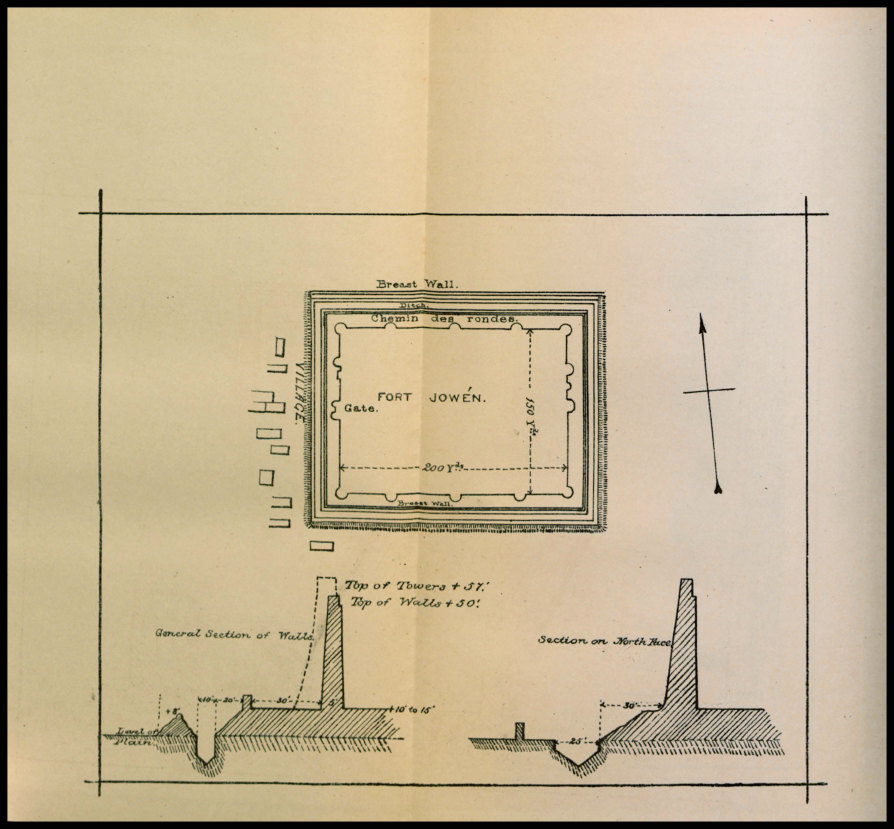
The sketch of Fort Juwayn was done by British officers in 1884. It shows: (1) the circumvallations of the fort comprising: (a) an embankment; (b) ramparts; (c) trench; (d) breastwall; (e) chemin de ronde (the patrol path); (2) two breastwall designs (parapet and mini-mound); (3) dimensions and layouts of curtain walls; (4) towers; and (5) two different types of trenches. I will discuss terms like battlements, curtain walls, trenches, etc., in subsequent posts.
The physiognomy of Fort Juwayn is not heterogeneous. Factors like geology (soil quality and type), terrain (topography) and building materials were factors in determining physiognomy of a fort. Given the dearth of stone and wood on the Iranian Plateau, Iranians developed fortifications with available materials like sand, clay, and straw. This did not mean that fort were weak. They were quite resilient against trebuchets, but not against cannon.
You can read more about Mongol, Turk, and Iranian warfare and fortified cities and citadels in my History of Herat, from Chingiz Khan to Tamerlane.
 Perspectives
You must be logged in to post a comment.