Potentially, the most dangerous scenario would be a grand coalition of China, Russia, and perhaps Iran, an ‘antihegemonic’ coalition united not by ideology but by complementary grievances.
Zbigniew Brzezinski, The Grand Chessboard (New York: Basic Books, 2016), p.55
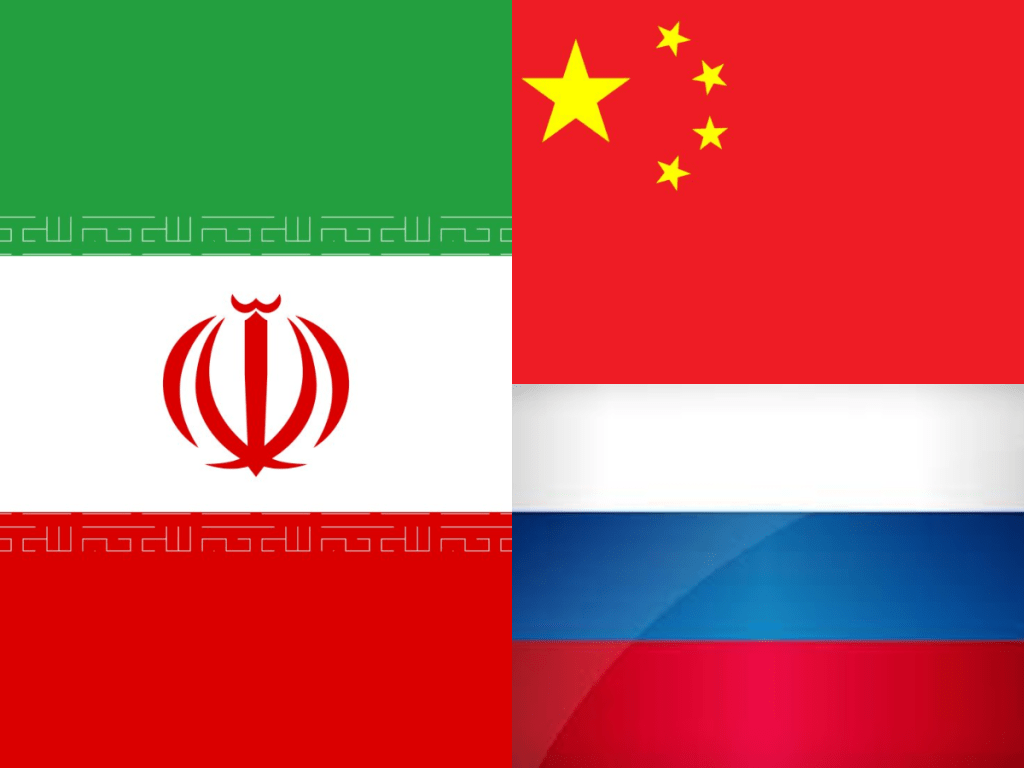
Essay evaluates the maturing ‘Tripartite Alliance’—Russia, China, Iran—at the two-year anniversary of Ukraine War, which fused the Alliance. Anger at U.S. and NATO transformed hitherto wary allies into partners. Part 1 covers background; Part 2 covers cooperation—with emphasis on Iran-Russia military exchanges. How will the Iran-Russia military relationship impact on U.S. and Israel?
Introduction
Tehran and Beijing cheered the Russian invasion of Ukraine. The figurative popping of champagne corks was in private. Both leaderships issued measured statements about the war and its cause. By launching a ‘special military operation’ against Ukraine on 24 February 2022, Vladimir Vladimirovich Putin showed resolve after patiently enduring ‘five expansions’ that brought NATO to the Russian Federation’s front door step. The Maydan coup of spring 2014; duplicity by Western states in refusing to implement the Minsk Agreements (confirmed by Angela Merkel and François Hollande);[1] and threats to include Ukraine in NATO, compelled him to protect Russia’s national interests.
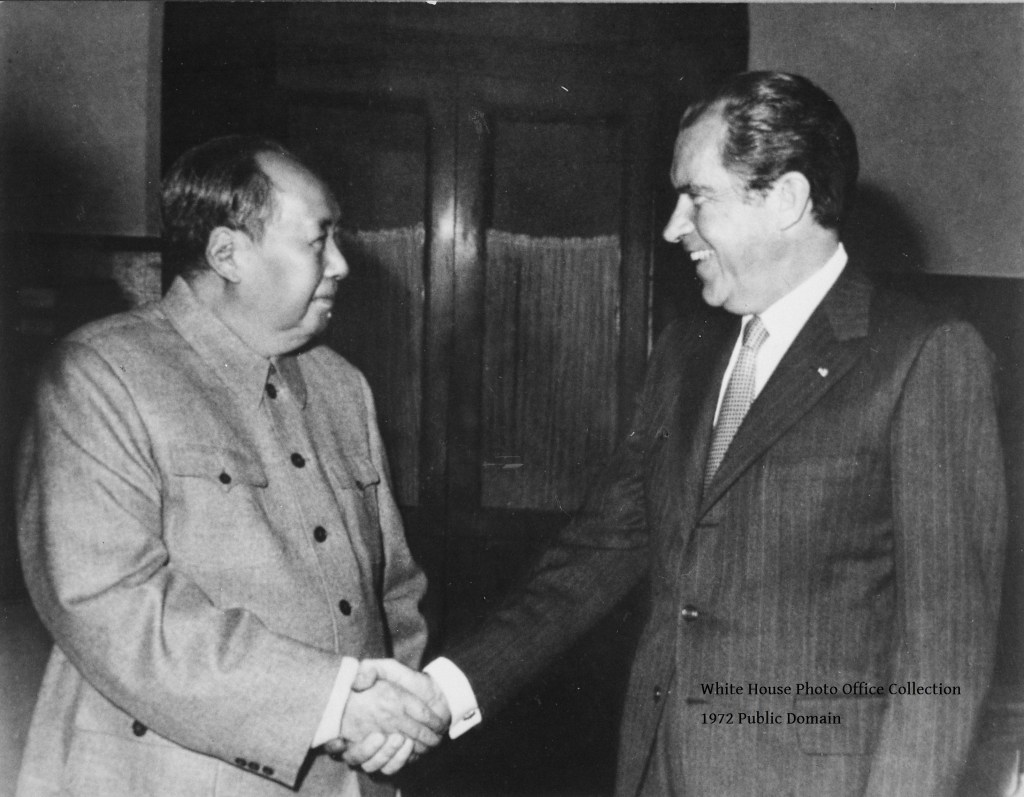
One of Richard Nixon’s principal goals in forging diplomatic relations with China in 1971 was to exploit the doctrinal schism between China and Russia. He sought to widen the Peking-Moscow schism into a chasm by offering China access to international markets, and by legitimizing the PRC’s (Communist) political system. Nixon’s diplomatic entreaties culminated in his historic February 1972 visit to China.
Serial betrayals by the United States on ‘one China,’ ‘not one inch eastward,’[2] Minsk Agreements, JCPOA, and much more, have brought Russia, China, and Iran to this pivotal moment in history.
Failure of American Statecraft
Biden and his coterie of national security and diplomatic ‘experts’—Lloyd Austin, Jake Sullivan, Victoria Nuland, Antony Blinken, et al., brought China and Russia together, thereby undermining half-century of American statecraft. Furthermore, they bonded Iran to Russia, creating a formidable multi-faceted partnership.
Moscow, Beijing, and Tehran are tired of endless threats and sanctions by the White House, Congress, and Washington’s vassal states:[3] Canada, EU, and UK. Ayatollah Ali Khameneʾi, Xi Jinping, and Putin had been chafing for years—decades with respect to Iran—at the arrogant pontifications and arbitrary actions of Washington, viz., demands for adherence to their still unpublished holy book, The Rules-based Order;[4] sanctions, NATO expansion, support for anti-Iran terror groups (MeK, Jundallah, Jaysh al-Adl, etc.), anti-Russia activities, and support for Taiwan’s independence despite Washington’s promise to recognize just ‘one China.’[5]
Moscow had not been a full member of the ‘Coalition of the Sanctioned’ until after it was subjected to thousands of sanctions following the 2022 invasion. Putin had tried to work with Washington on geo-political and economic concerns,[6] but Washington decided, through hubris, to disregard the Kremlin’s legitimate economic and security interests. Hence the war in Ukraine and anti-Russian sanctions. A ‘Tripartite Alliance’ was born.
A Brief History of Russia-Iran Relations
Russia and Iran are not ‘natural’ allies—unlike Iran and China. Iran and China have had economic relations dateable to pre-Islamic times. Grandsons of Chingiz Khan ruled Iran and China—the oldest, wealthiest, and most politically, culturally, economically, and scientifically advanced lands in the Mongol Empire. Under Pax Mongolica, economic, scientific, and cultural exchanges between Yüan China (1260–1368) and Ilkhanid Iran (1256–1335) burgeoned.[7] Iran-China relations have continued and been cordial. When the U.S. and its allies were supplying weapons to Iraq during the Iran-Iraq War (1980-88), China supported Iran. Donald Trump’s unilateral withdrawal from JCPOA forced Iran to shelve its ‘neither east nor west’ (na sharq, na gharb) policy, and sign a twenty-five-year economic and military pact with China.
Exchanges between Rus and Iran, however, mostly involved trade; for instance, silks and silver.[8] More importantly, Russia and Iran have clashed militarily on multiple occasions between 1651 and 1828—to the detriment of Iran. Since pre-Islamic times the modern states of Azerbaijan, Armenia, Dagestan, and Georgia belonged to ‘Greater Iran’ (Iran-i buzurg; also called ‘land of Iran,’ Iran-zamin; ‘empire of Iran,’ Iranshahr). They were lost in the 19th-century. The Treaty of Gulistan (1813; after the 1804–13 Russo-Persian War) cost Iran all/part of: Dagestan, eastern Georgia, northern Armenia, most of Azerbaijan. The Treaty of Turkmanchay (1828; the 1826–28 war) ceded to Russia the south Caucasus. By the Treaty of Akhal (1881), Iran recognized Russia’s authority over lands largely comprising modern Turkmenistan. Iran’s Qajar shahs (1789–1925) were too militarily and economically enervated to resist. They had earlier lost the Herat region (Afghanistan) to Britain (Treaty of Paris, 1857).
During WWII, Soviets allied with Britain and USA to militarily occupy Iran (1941–46), which resulted in the plunder of Iranian agricultural and energy resources; and famine that killed hundreds of thousands of Iranians.[9] Soviet-Iran relations were cool during the Cold War. Muhammad Riza Shah (r. 1941–79) was propped by USA; USSR armed Iraq during the Iran-Iraq War (1980–88). Iranian and Russian political and military interests were frequently at odds in the five centuries since official diplomatic relations were established in 1521.
In recent times, Iran cooperated with Russia on numerous fronts, most notably on the development of Iran’s nuclear program; and in Syria where Russian and Iranian forces battled ISIS and assorted U.S.-backed ‘rebels.’ However, Iranians were wary of Russia. Although Russia had been steadfast in its support of al-Assad and Iranian forces in Syria, Putin continued to cooperate with Israel in ways detrimental to Iranian interests; for instance, Russian air defense systems officers coordinate with IDF to permit Israeli jets to traverse Syrian airspace to strike Syrian, IRGC, and Shiʿa militia targets. Since 7 October 2023, Russians have continued to allow IDF aircraft to safely operate inside Syria.
Benefits to Iran from the Alliance
Benefits from allying with Russia and China produce economic and military benefits to Iran and its Shiʿa partners. There have been diplomatic benefits, too, like the Saudi-Iran ‘rapprochement’ in spring 2023. I will address cooperation in more detail in Part 2 of ‘Coalition of the Sanctioned.’
Please join my FREE mailing list
[1] Merkel: ‘Das Minsker Friedensabkommen von 2014 nach der Besetzung der Krim und des Donbass durch Russland nannte sie einen “Versuch, der Ukraine Zeit zu geben”,’ ‘Merkel verteidigt ihre Russland-Politik.’ Süddeutsche Zeitung (7 December 2022).
Hollande: ‘Pensez-vous également que les négociations de Minsk visaient à retarder les avancées russes en Ukraine? Il répond “Oui, Angela Merkel a raison sur ce point”.’ ‘François Hollande confirme que les Accords de Minsk n’étaient qu’une manœuvre occidentale.’ Réseau Voltaire (31 December 2023).
[2] U.S. Secretary of State James Baker told Mikhail Gorbachev on 9 February 1990 that NATO will not expand, ‘inch eastward.’ See ‘NATO Expansion: What Gorbachev Heard,’ at National Security Archive.
[3] Merriam-Webster: ‘a state with varying degrees of independence in its internal affairs but dominated by another state in its foreign affairs and potentially wholly subject to the dominating state.’ See also, J. Shapiro and J. Puglierin, ‘The Art of Vassalization: How Russia’s War on Ukraine has Transformed Transatlantic Relations’ (War on the Rocks, 29 June 2023).
[4] ‘The phrase is a linguistic atrocity, while the concept draws attention to American hypocrisy, in the Middle East and beyond.’ Andreas Kluth, ‘Ditch the “Rules-Based International Order”’ (Bloomberg, 8 February 2024).
[5] ‘In the early 1970s, this consensus was translated by American statecraft into a stipulation that there was only “one China.” When he visited Beijing in 1972, President Nixon solemnly declared in writing that the United States did “not challenge” the cross-Strait consensus on this.’ See ‘War with China over Taiwan?’ by U.S. Amb. Chas Freeman (he was with Nixon).
[6] See 6 February 2024 interview of Putin by Tucker Carlson (https://tuckercarlson.com).
[7] See, e.g., Thomas Allsen, Commodity and Exchange in the Mongol Empire: A Cultural History of Islamic Textiles (Cambridge: Cambridge University Press, 1997); idem, Culture and Conquest in Mongol Eurasia (Cambridge: Cambridge University Press, 2001).
[8] See, e.g., Rudy Matthee, The Politics of Trade in Safavid Iran: Silk for Silver, 1600–1730 (Cambridge: Cambridge University Press, 1999).
[9] Mohammad Gholi Majd, Iran Under Allied Occupation in World War II (Lanham, MD: University Press of America, 2016).
 Perspectives
You must be logged in to post a comment.