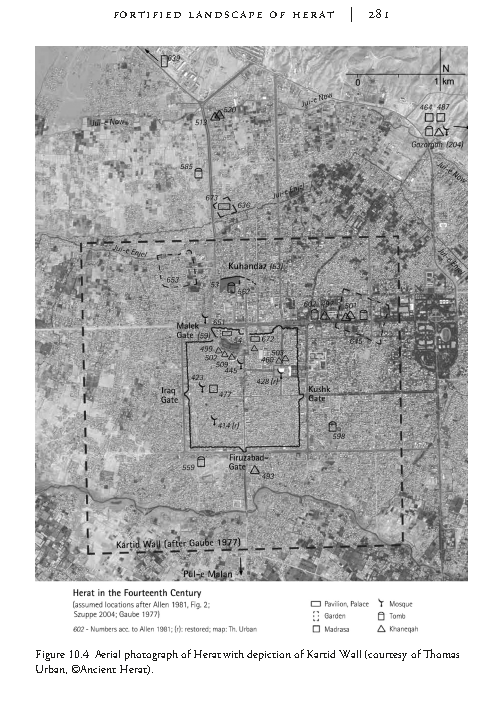
Malik Muʿizz al-Din Kart (died ah 771/ad 1370) erected a perimeter wall (shahr-band) to protect Herat’s ‘suburbs.’ This ‘Kartid Wall’ was constructed before 752/1351. The contours of the wall are difficult to trace because Temür (‘Tamerlane’) demolished them when he captured the city in ah 783/ad 1381. However, Terry Allen offers a descriptive reconstruction of the wall. Based primarily on a proffer by Heinz Gaube, the putative perimeter of the Kartid Wall was outlined on a map by Thomas Urban (see Figure 1). The wall is square, c. 3.80–4.00 km x 3.80–4.00 km. If we simplify this to 4 x 4 km, the wall’s perimeter is 16 km/10 mi. Area encompassed by the wall is c. 16 km2 (c. 6.2 mi2).
The contexts for Bukhara’s ‘Wall of Kanpirak’ (Diwar-i Ka[m]pirak; Kampir-Diwal: ‘the old woman’), helps in understanding why the Kartid Wall was erected. Kanpirak Wall’s perimeter was over 250 km. The reason for the existence of Bukhara’s long wall is instructive. The History of Bukhara relates how Bukharan notables had complained to the governor of Khurasan (sometime around ah 166/ad 782), about ‘infidel Turks’ plundering Bukharan villages and dragging Muslims into captivity. The governor ordered the amir of Bukhara:
to build walls for Bukhara so that all of the villages of Bukhara would be inside those walls, similar to Samarqand, so the Turks could not enter the district of Bukhara […]. It was completed in the year 215/830.
The Kartid Wall was probably a robust earthen mound with mud/clay walls and four gates. One gate is known: Darwaza-yi Ansari—the north gate, to the highway to Gazurgah. There will have been a series of intervaled watch towers. This defensive posture would have been sufficient to monitor hinterlands, villages, hamlets, granaries, watermills, and such lying beyond Herat’s enclosed ‘suburbs’; and to defend neighborhoods against surprise attack by predators. If a threat is detected, alarms are raised and reinforcements surged to secure the threatened sector. The Kartid Wall never far from garrisons inside Herat, the city’s citadel, Qalʿa-yi Ikhtiyar al-Din, and the citadel outside Herat, Qalʿa-yi Iskilchih.
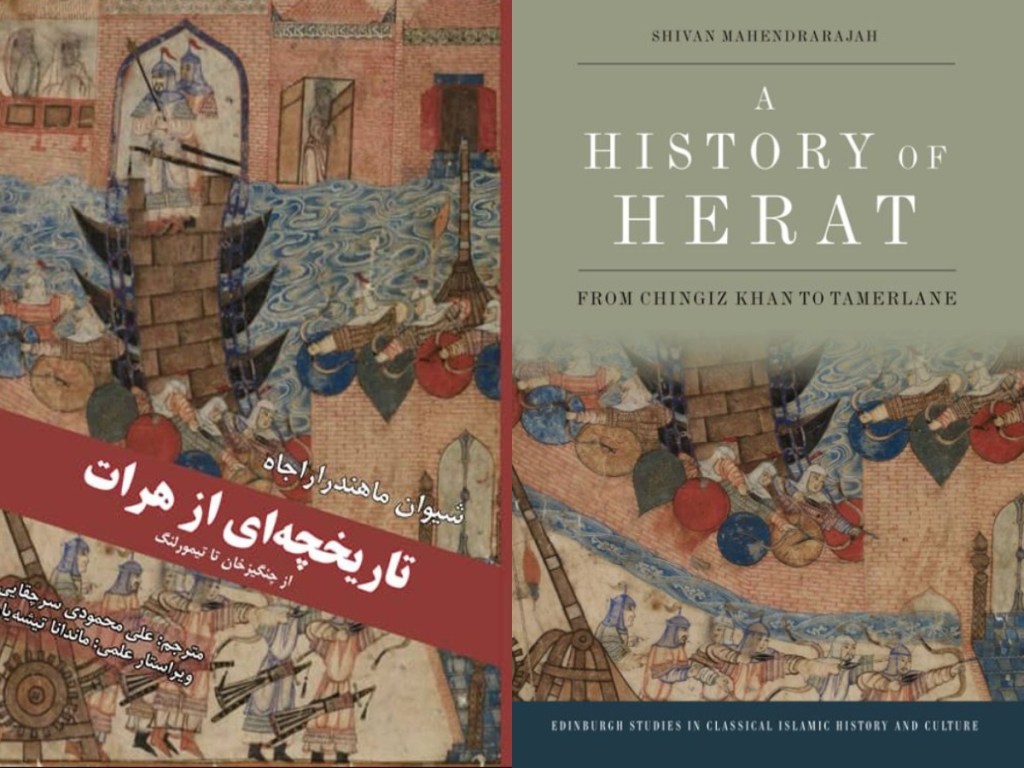
You can read more about Herat and its fortifications in my book, A History of Herat. Available in English and Persian.
 Perspectives
You must be logged in to post a comment.