Introduction
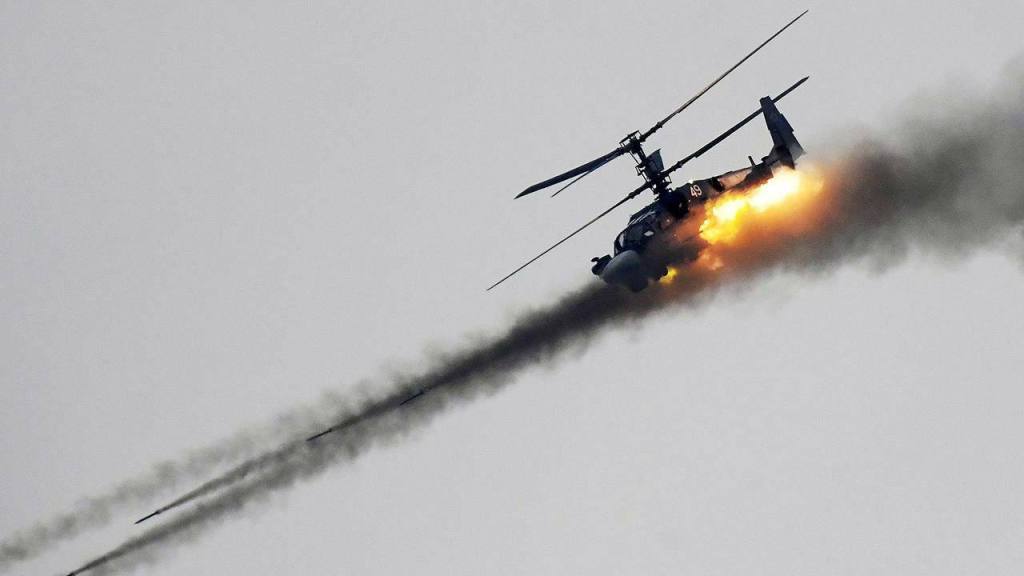
I am not a combat helicopter man, being from the “boom, boom, boom, artillery” school; hence my focus on artillery and missile systems. However, I have fallen in love with Russia’s Ka-52 “Alligator.” It is clearly the finest attack helicopter in the business; far superior to the Cobra and Apache attack helicopters that witnessed action in Afghanistan and Iraq.
Combat Helicopters
Artillery is the “king of battle”; it opens the door for infantry and cavalry. This has always been so, even in pre-modern times when artillery took the form of siege engines (ballistae, onagers, catapults, trebuchets, etc.). As stated in my History of Herat (Edinburgh, 2022, p. 26) on the Mongol siege of Nishapur (Iran) in 1221: “Artillery is powerful and terrifying, but artillery by ‘itself cannot win battles or take cities…the final blow must be delivered by infantry and cavalry’.” Artillery is limited by physics: maximum range and fixed trajectory. Target acquisition—coordinates—had to be supplied to artillerymen.
The introduction of combat helicopters changed battlefield dynamics through delivery of aerial firepower—artillery from the sky—where support for infantry and cavalry (now called armor) could be supplied by combat helicopters. Helos became “artillery on demand.” This was evident in Vietnam, where the venerable “Huey” (Bell UH-1 “Iroquois”) and “Jolly Green Giant” (Sikorsky MH-53 “Pave Low”) performed admirably. Hueys, which were also used for MEDEVAC, emitted distinctive sounds from its rotors; hence the saying, “ain’t nothing like the sound of an inbound Huey.”
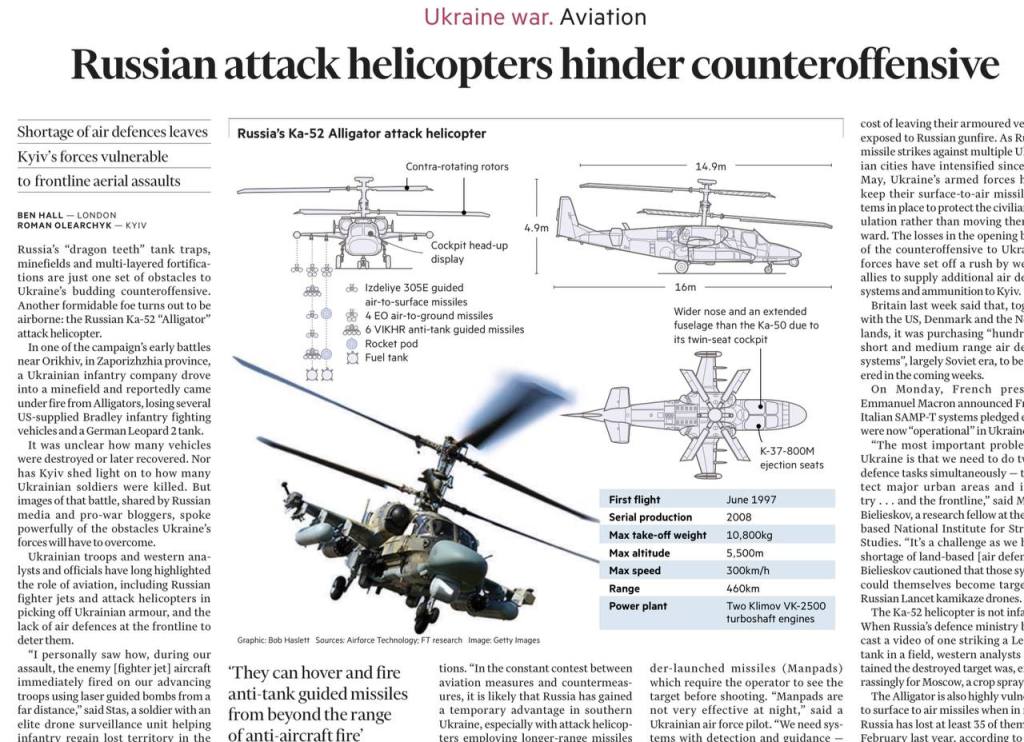
Cobras and Apaches performed well in Afghanistan and Iraq, but the Kamov-52 “Alligator” is in a class by itself. I will not bore you with the Alligator’s specifications, which are online, but will focus on attributes made known from combat in the U.S.-led proxy war on Russia. The ‘Gator is so good, FT complained about it (graphic below).
Limitations of Attack Helicopters
One of the limitations of Cobras and Apaches—helos, in general, including Kiowas and Blackhawks—is that they are vulnerable to small arms fire (SAF) and rocket-propelled grenades (RPG), particularly if a helo’s tail rotors are hit by RPGs. The most notorious instances of this are from Mogadishu, Somalia (the “Blackhawk Down” story) and Afghanistan (2011), where one military dog and 38 men died when a Chinook was downed. Dozens of Cobras and Apaches, and other helos, went down in both theaters due to SAF and RPG strikes.
The Russian ‘Gator
A long documentary (above) on the Alligator addresses its capabilities. But I am most impressed by two videos from Ukraine that reflect the Alligator’s prowess in combat. First, an Alligator that had its tail rotor shot off (not sure how; SAF, RPG, or another weapon), but the pilot was able to cavalierly fly back to base. A Cobra or Apache just cannot. The Alligator is aided by its coaxial main rotors—rotors mounted one above the other on concentric shafts, having the same axis for rotation but turning in opposite directions (contra-rotating)—that continue to provide lift and prevent spinning or loss of control when the tail rotor ceases to function.
Lastly, this latest video, which shows the Alligator hugging the ground at altitudes of no more than a few meters (watch the altimeter in the cockpit). Simply a delight.
 Perspectives
You must be logged in to post a comment.