Rashid Khalidi’s statement that the Axis (AoR) “was designed by Iran to protect the Iranian regime. . . . It wasn’t designed to protect Palestine,” is ahistorical on multiple levels, but raises questions such as (1) who is in/out of AoR?; (2) what is Iran’s strategic goal?; (3) how will AoR help Iran achieve its objectives?
Rashid Khalidi
Disclosure: I met Khalidi when I studied at Columbia, but never took his lectures or seminars.
Khalidi’s controversial talk is on Spotify. His affinities lie with PLO, where he was allegedly “‘a director of the Palestinian press agency,’ … WAFA, the PLO press agency, where Mr. Khalidi’s wife, Mona, was chief English-language editor in 1976-82.” PLO was an umbrella for multiple organizations, one of which is Fatah, formed by Yassir Arafat (d. 2004), now led by Mahmoud Abbas (president of “State of Palestine,” 2005–present). Khalidi’s views tend to favor pro-Israel appeasers like Abbas, whose PA cooperates with Israel: it is currently murdering Palestinian resistance fighters in Jenin. An article on Khalidi addresses his ‘ahistorical’ remarks on AoR and Iran.
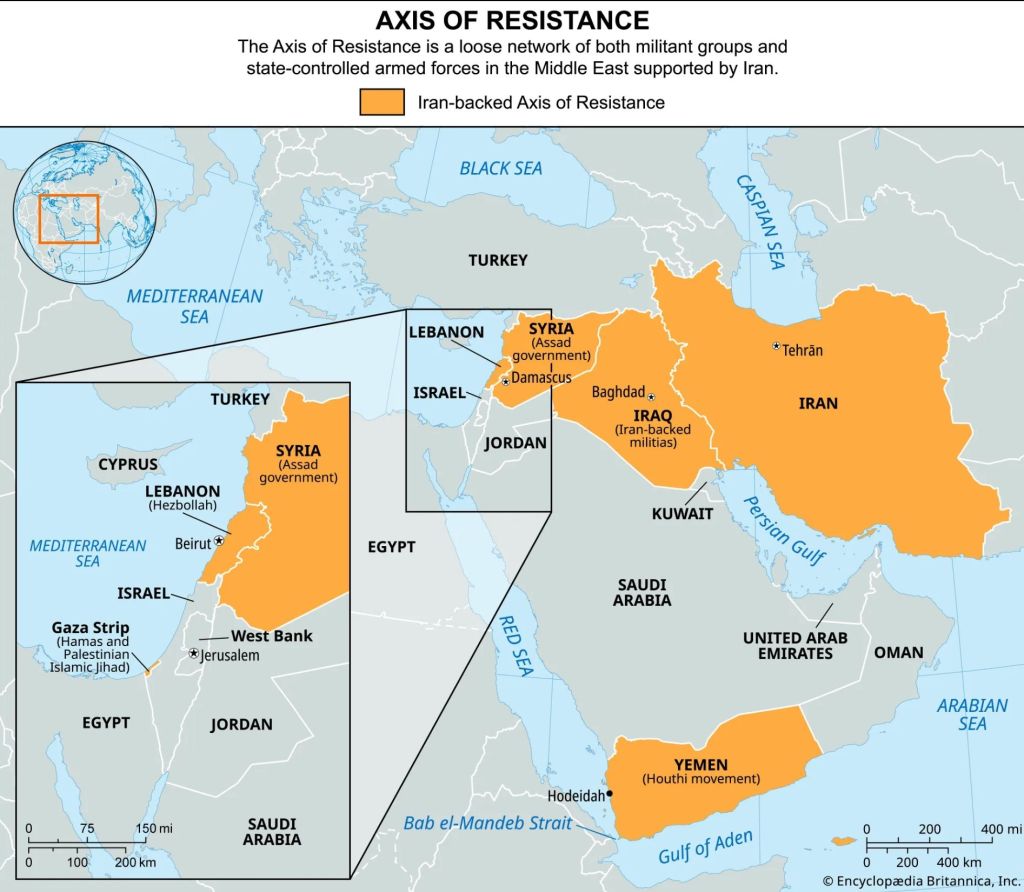
AoR Membership
Members include Iran, Hizballah, Ansarallah (Houthis) and assorted Shiʿa groups in Iraq and Syria. But is Hamas an actual member?
Iran and Hizballah: they are siblings born three years apart (1979 and 1982, respectively). The brothers share a common faith, Twelver Shiʿism (or Twelve Imams), with centuries-long intellectual and historical ties between Lebanese Shiʿa and Iranian Shiʿa.
Hizballah emerged with Israel’s 1982 invasion of Lebanon. IDF invaded to expel PLO, which had relocated to Lebanon (1971–82) following their expulsion from Jordan in 1971. PLO fled Lebanon and based itself in Tunis (1982–1991).
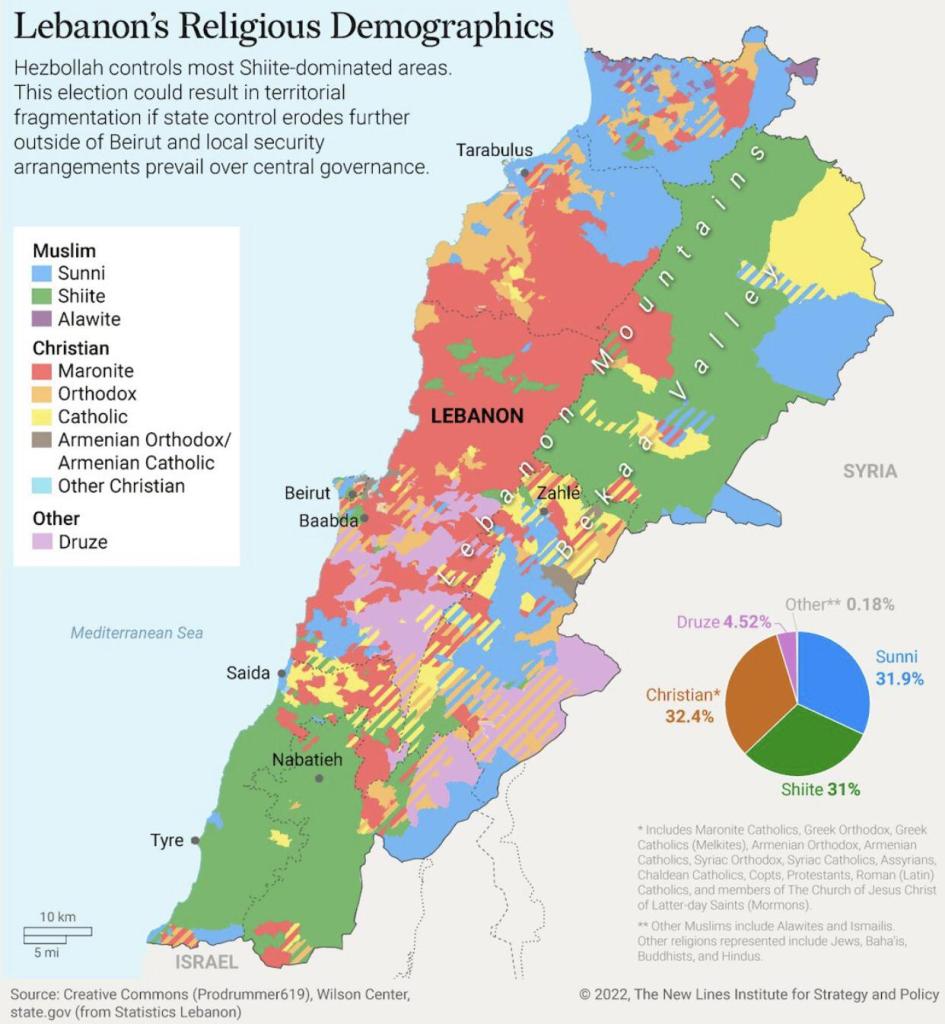
PLO had been booted from Jordan because they had become a frightful nuisance. In Lebanon, too, PLO set about making “friends” with the natives (1971–82). Lebanese Shiʿa, whose native lands are principally in the south (i.e., north of the Israel-Lebanon border) and northeast (see map), had been victimized by PLO. There was no Hizballah in June 1982; indeed, many Shiʿa welcomed the ejection of PLO. Ehud Barak (Israeli PM, 1991–2001) said, “[w]hen we entered Lebanon…there was no Hezbollah. We were accepted with perfumed rice and flowers by the Shia in the south. It was our presence there that created Hezbollah.”[1] Yitzhak Rabin said, the invasion let “the Shi’ite genie out of the bottle.”
Despite Iran’s distractions with the “Imposed War” (Iran-Iraq War, 1980–88), Tehran helped Hizballah expel U.S. Marines and IDF. Iran and Hizballah have a symbiotic relationship. Their connections today are martial, ideological, intellectual, political, and emotional.
Iraqi Shiʿa: manifold groups emerged with the U.S.-led invasion of Iraq (2003). Twelver Shiʿa of Iraq have historical and cultural bonds that date to the formative centuries of Islam. Artificial borders that had separated the two communities, particularly under Saddam Hussein, were all but dissolved. Several Iraqi Shiʿa militias coalesced and allied with Tehran.
Syrian Shiʿa: Twelver Shiʿa militias emerged during the Syrian Civil War (2011–24). They are minor relative to Iraqi groups, but sought patronage from Tehran. Syria under Bashir al-Assad, as I have noted in an earlier post, was an inactive member of AoR.
Ansarallah: The Yemeni militia are Zaydi Shiʿa (Five Imams), ideologically distinct from Imami Shiʿism. Ansarallah (Houthis) emerged as a political entity in the 1990s, but their relationship with Iran developed as a result of the U.S.-backed Saudi-UAE war on Yemen (2014–present). It was and remains a marriage of convenience.
The reader will have noted that so-called Iranian proxies are organic and indigenous; their alliances with Iran are the consequences of foreign interventions. The common denominator binding the AoR is not Israel, but the United States. In my essay, “IRGC and Shiʿa Militias in Iraq, Syria, and Lebanon: ‘Why We Fight,’” I examine why diverse Shiʿa militias and Iran are challenging the United States.
Hamas: Hamas, born in 1987, opposes the “secular approach of [PLO] to the Israeli-Palestinian conflict.” Hamas and Hizballah are not “natural” allies. Hamas supported the U.S.-backed “rebels” that arose against Assad. On 24 Feb 2012, Ismail Haniyeh, standing at al-Azhar Mosque in Cairo, before a crowd chanting, “No to Iran. No to Hezbollah. The Syrian Revolution is an Arab revolution,” proclaimed Hamas’s support for “the people of the Arab Spring …,” and lauded the “heroic Syrian people who are striving for freedom, democracy and reform.” Hamas did more than offer words; Izz al-Din al-Qassam Brigades fought alongside “rebels,” including the ISIS “rebels” at Idlib (see ibid., p. 14). Hamas was implicated in bombings in Lebanon in 2013 (ibid., 15). The above is for illustrative purposes; there is much more. Hamas quit Syria in 2012; restored ties with Assad in 2022; and in December 2024, “Hamas hails ‘freedom and justice’ gained by Syrians after Assad’s fall.”
Hamas has the blood of Shiʿa on their hands: Iranian/IRGC and Lebanese/Hizballah blood. Hamas is treacherous. Only a fool clutches a venomous cobra to his bosom.
Iran is aware of Hamas’s nature. It is just a tool. The relationship is that of carpenter to his hammer. Hamas is a member of AoR for only so long as it can hammer nails into Zionist skulls. Once Hamas is no longer drilling holes into Zionists, Iran will discard Hamas like a used condom.
Conclusions
Everyone else is with us; literally, every other single place on the face of the earth is in support of the Palestinians, yet all of them together aren’t a hill of beans compared to the United States and Israel, because the United States and Israel can basically do anything they please. They are the world superpower; they are the regional superpower.
The above quote by Khalidi shows that he has the answer to Iran’s strategy, but that it eludes him. The problem, as he noted, is the U.S., “because the United States and Israel can basically do anything they please” in West Asia. The Shiʿa entities (Iranians, Lebanese, Iraqis, Syrians, and Yemenis) seek to expel the United States from West Asia (see my “Why We Fight”). Matthew Petti observed in an essay based on Khalidi’s interview that the post-Soviet Union (post-1991) U.S. strategy in West Asia is “to keep the Israelis in, the Iranians out, and the Arabs down.” Iran and its Shiʿa brethren are aware of this American scheme; hence their strategic objective of defeating the U.S.
Once Israel’s patron and protector are militarily defeated, Israel will be isolated, docile, and amenable to the creation of a Palestinian state. Iran is playing a “long game”—too long a game, IMO—but that is the nature of the game the Iranians are playing.
[1] Augustus Richard Norton, Hezbollah (Princeton: Princeton University Press, 2007), 33.
 Perspectives
You must be logged in to post a comment.