Hundreds of Afghans arrested for aiding Israel; suspected Mossad ties to Ahmad Massoud’s “National Resistance Front”; “Westoxified” (gharbzadegi) Afghan diaspora hates Shia Iran but expects Tehran to host Afghan refugees; ca. 250,000 Afghans deported in June 2025.
Afghan Refugees in Iran: Primer
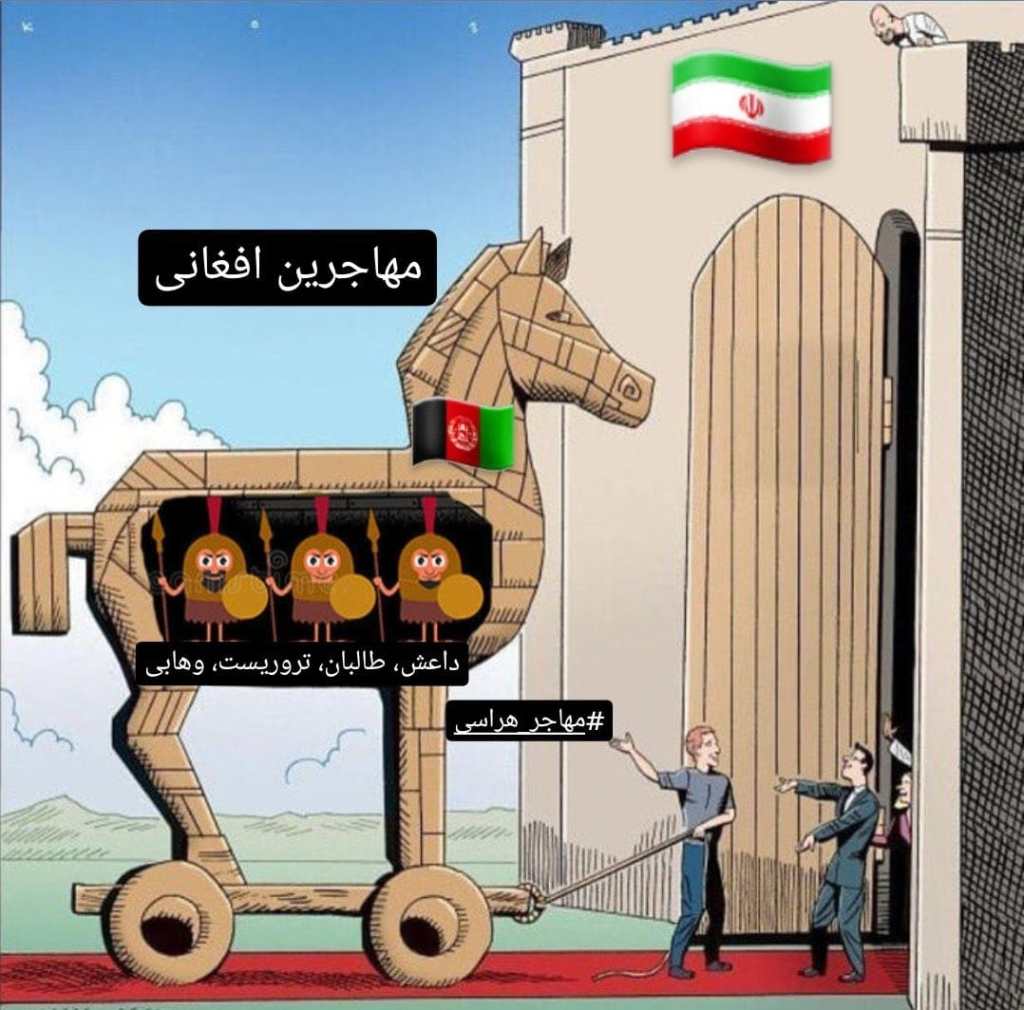
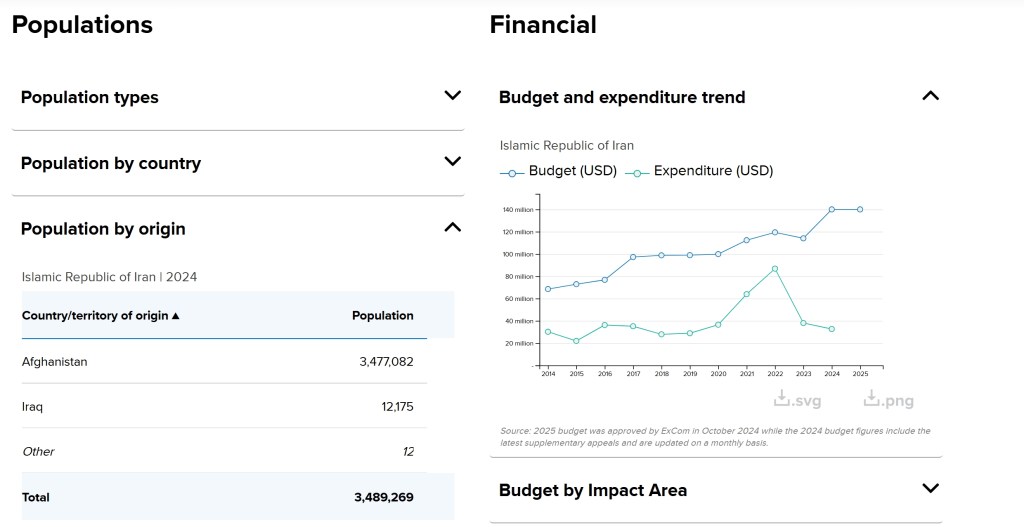
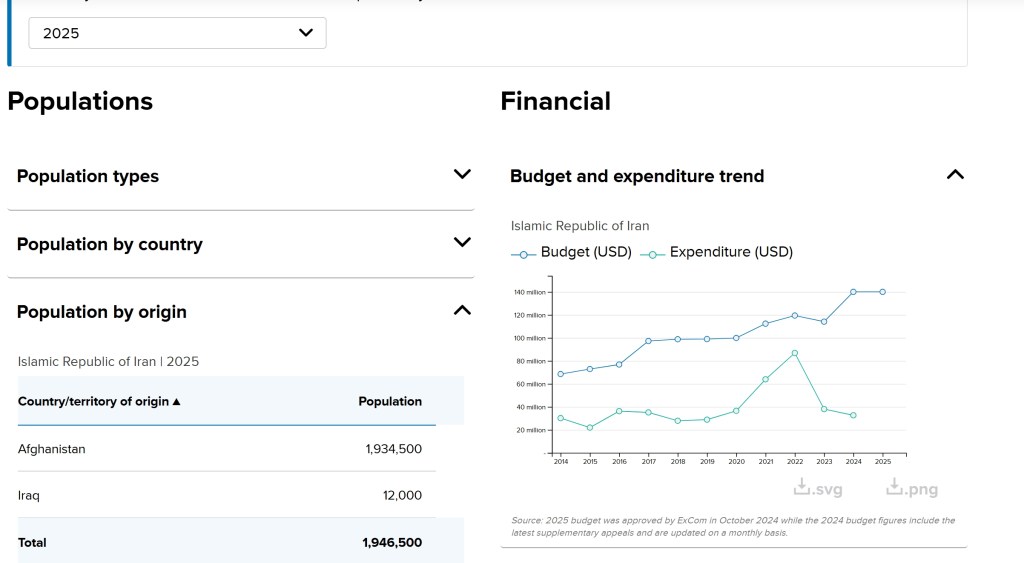
Iran has been subjected to two broad classes of refugees from Afghanistan: “Class 1,” following the Soviet invasion in 1979; and “Class 2,” following the Taliban’s victory in 2021 (see 7 Jan 2025 study by Migration Policy Institute). Class 1 Afghans present Tehran with social and political complexities: first, many hold settled status, and/or are married to Iranians, and have children born and raised in Iran. Class 2 refugees are simpler: they are legal (if registered) or illegal (if unregistered). Class 2 refugees have no community roots in Iran. In 2024, Iran hosted 3,477,082 Afghan refugees (Fig. 1). The illegal Afghan population in Iran is ca. 500,000. The plan for 2025 was to reduce the number of Afghans from 3.5 mil. to 1.9 mil. (Fig. 2).
Economic Migrants
Afghan refugees in Iran are not locked in camps and fed slop three times a day. UNHCR writes, “[i]In Iran, thanks to the Government’s progressive and inclusive policies, refugees have been given access to education, health, and livelihoods opportunities—helping them thrive, not just survive.” The Islamic Republic of Iran covers registered refugees under its Universal Public Health Insurance (UPHI) program—same as for Iranian citizens. Afghan children can attend primary and secondary schools (an important factor for parents with daughters); adult literacy programs are available to men and women (Afghan women need literary programs). Afghans also have access to banking, employment, and livelihood schemes. Afghan refugees secure privileges, benefits, and physical safety unavailable to them under the Karzai and Ghani regimes and the Taliban. Most Afghan “refugees” in Iran are economic migrants.
Afghans and Mossad
Hundreds of Afghans have been arrested since 13 June. About 400 arrested in a workshop near IRGC General Command Headquarters (Tehran). A tunnel complex was below the workshop (a video was released showing detainees and tunnels, but no evidence of weapons or explosives was provided). Eighteen Afghans were arrested in Mashhad, 18 June, in a workshop where they were allegedly building drones. (The attack on Mashhad Airport, 15 June, was by a sabotage cell using drones.) In a police video, blindfolded men confessed to working with Mossad. Two men stated they were Afghans from Badakhshan; another man was Iranian. On 18 June, an alleged bomb maker from Afghanistan was arrested in Shahr-i Rayy (near Tehran). Additional arrests are known, mainly in Tehran and Mashhad, with six Afghans arrested in Luristan (west).
Afghans claim they are being scapegoated, and that Iranians are being mean to them. Be that as it may, Iran is holding a mixed bag of suspects: Iranian members of an established terror organization, Mujahidin-i Khalq Organization (MKO); Baluch separatists; and Bahais, Kurds, and Afghans. The number of suspects in custody is unclear, as are affiliations, ties to Mossad, and evidence seized.
MKO and Baluchi separatists have longstanding ties to Mossad and CIA; the Bahai cult is based in Haifa and hates the Islamic Republic; Iraqi Kurds have close ties to Mossad and CIA (I have written elsewhere about how CIA enlisted Kurdish leader Masoud Barzani in a plan to topple Saddam). But Afghans? How did they get involved? Even if just a fraction of the hundreds of Afghans in custody are connected to Mossad, who recruited them? It is difficult to recruit agents inside a country, and setup cells and equipment; but it easier to recruit and train them overseas, necessitating only infiltration of men and equipment. Fingers are pointing at Ahmad Massoud’s National Resistance Front (NRF). It has an abundance of Persian-speaking fighters with specialized training. NRF fighters can infiltrate Iran from Afghanistan or Kurdistan (if transported to Irbil by Israel or U.S.) and blend with Iranians.
“Westoxification” of Afghan Diaspora and NRF
It is not difficult to imagine Afghan involvement in Israel’s war on Iran. NRF only has notional ties to Iran, Russia, and China, but has solid ties to the West (US, CAN, UK, EU, AUS, NZ). NRF has bet its future on military support from the West, believing NRF will receive U.S. military assistance in overthrowing the Taliban. To this end, as I wrote in “Afghan Follies” (Jan. 2025), “NRF has allied with Zionists and American neoconservatives.” See also the essay on NRF by Luke Coffey of the Hudson Institute, a neoconservative redoubt.
NRF and Afghan diaspora are infatuated with the West; they eschew working with Iran, Russia, and China to advance their political objective vis-à-vis Afghanistan. NRF assuredly believes the West can topple the Islamic Republic of Iran with its attack dog, Israel. If “regime change” is successful, NRF would establish bases in eastern Iran from which to attack the Taliban.
“Westoxification” or “Occidentosis” (gharbzadegi) is the title of a celebrated book by the Iranian writer and thinker, Jalal Al-e Ahmad (d. 1969). Gharbzadegi “describe[s] the fascination with and dependence upon the West to the detriment of traditional, historical, and cultural ties to Islam and Islamic world…” Afghan diaspora are afflicted with “Westoxification.” They subscribe to the political objectives of the West; specifically, loathing of Iran, Russia, and China. For example, diaspora tend to support Ukraine over Russia. Diaspora Afghans do not support Israel overtly (cf. Iranian monarchists, MKO, Bahais, etc.), but vocally—and polemically—criticize Iran. Comments like “dirty Shia,” “I hope the [Iranian] regime falls,” “f**k Iran,” “I hate Iran for [fill-in the blank],” etc., are common on social media. NRF reflects the Afghan diaspora’s “Westoxification.”
NRF is predominantly Tajik. In 2001, Tajiks were utilized by the West to topple the Taliban. Once that task was done, Tajiks were discarded like used condoms: they were marginalized; leaders that had helped the U.S. were labeled “warlords” and ejected from government (e.g., Ismail Khan, governor of Herat). The political, diplomatic, and military organs of the West worked assiduously to centralize and solidify Pashtun power, and to deny Tajiks representation in a devolved political system. Despite enduring twenty years of abuse by the West, when Kabul fell in 2001, NRF ran crying to the West—the West that abandoned Afghanistan! Beijing, Moscow, and Tehran offered assistance, but “Westoxified” NRF slapped their hands away, and focused on London, Brussels, and Washington. NRF are like beaten dogs, wagging tails and belly-crawling to the West, hoping for something other than another beating. NRF are ideal candidates to be tools of Israel’s “regime change” operation.
Conclusions
I have made inquiries with Iranian sources re the investigation of suspects, but have received silence. Iranian security services are being tight-lipped even with Iranian media.
Iran was in the process of returning illegals when war broke. The pace of expulsions accelerated in June as a consequence of the war. It behooves Iran to rid itself of Afghan undesirables irrespective of involvement with Mossad. Iran, a country under sanctions, coupled with UNHRC shortfalls in funding for programs, cannot afford to indefinitely host millions of economic migrants given the financial burdens of UPHI and (free) primary and secondary education.
The Afghan diaspora will kvetch. They expect Iran to host 3.8 million Afghans, but I have yet to see essays by Afghan journalists praising Iran for helping their countrymen. However, there is plenty of bitching, like “Afghan refugees face ever increasing hardships to stay in Iran.” What right do Afghans have to live in Iran? It is not Iran’s responsibility to pay for the problems caused by serial U.S. failures in Afghanistan, just as it is not America’s duty to host tens of millions of economic migrants from the Mexican narco-state. Iran loses nothing by expelling “Class 2” Afghan refugees.
 Perspectives
You must be logged in to post a comment.