Analysis of SM-2, SM-3, SM-6, PAC-3, and THAAD interceptors used (10/23 to 08/25), costs, and remaining stockpiles. If Iran enters round two of the Iran-Israel War holding nuclear deterrence, Iranian missile barrages can pound Israel into capitulation.
Introduction
Analyses of interceptor stockpile depletion and costs incurred by U.S. taxpayers in the defense of Israel over twenty-two months. Covers U.S. defensive operations against Iran in April 2024, August 2024, and June 2025; and against Ansarallah (“Houthis”) in the Red Sea, from Oct. 2023 to Aug. 2025. As the animation shows, multiple defensive layers manned by U.S. and Allied air defense batteries on land and sea protected Israel. Precise numbers of all interceptors launched and realized interceptions are classified.
Methodology & Caveats
I scoured the internet for open-source reports on interceptor launches by U.S. land- and sea-based air defense assets. However, (1) due to misinformation and disinformation in reports; and (2) authors focusing on different theaters (e.g., Red Sea) and time periods (e.g., Twelve-Day War), precise figures cannot be determined. See, e.g., reports of 16 June 2024, 17 June 2024, 23 July 2025, and 25 July 2025. Lacunae, assumptions (by me), cost averaging (by me), classification of data, etc., lend uncertainty to the figures published here. I present the most conservative estimates.
An example of difficulties encountered in estimating is with the Standard Missile 2 (SM-2), which is deployed on Aegis-equipped U.S. Navy destroyers and cruisers involved in Red Sea operations. SM-2 is used for lower tier defense—anti-ship cruise missiles, drones, aircraft, surface threats. Published reports yield median SM-2 usage of ≈ 100; however, one report claims usage through June 2025 is 268. Although 268 is an outlier, it is surely closer to the truth given the constancy and tempo of Yemeni ops against the U.S. Navy over 22 months. The same report claims higher SM-3 (159) and SM-6 (280) usage than given by me. If that report is correct—and I suspect it is close to reality—U.S. stockpiles are lower and costs to U.S. taxpayers are higher than in this essay.
Costing is problematic because interceptors are purchased in blocks at ever-increasing prices. I do not know which blocks were utilized. Average unit costs are used for SM-2, SM-3, SM-6. Alternatively, I could use FIFO or LIFO, but that is another layer of assumptions. On PAC-3 costing, see explanation below.
Cost Calculations
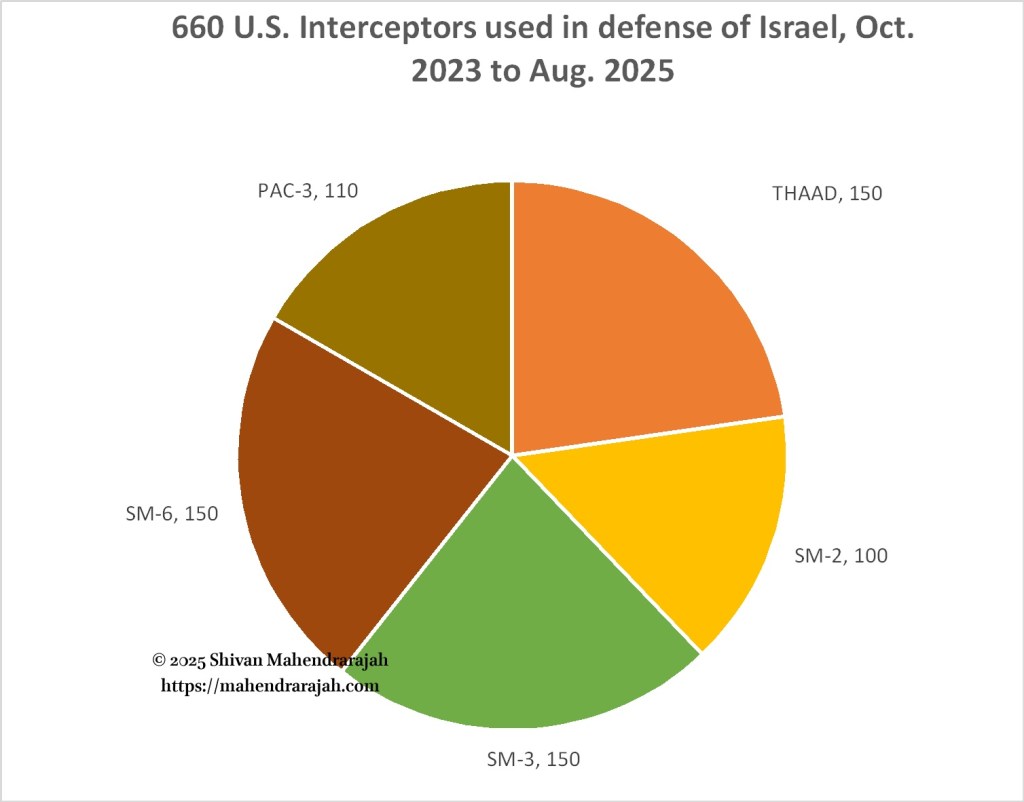
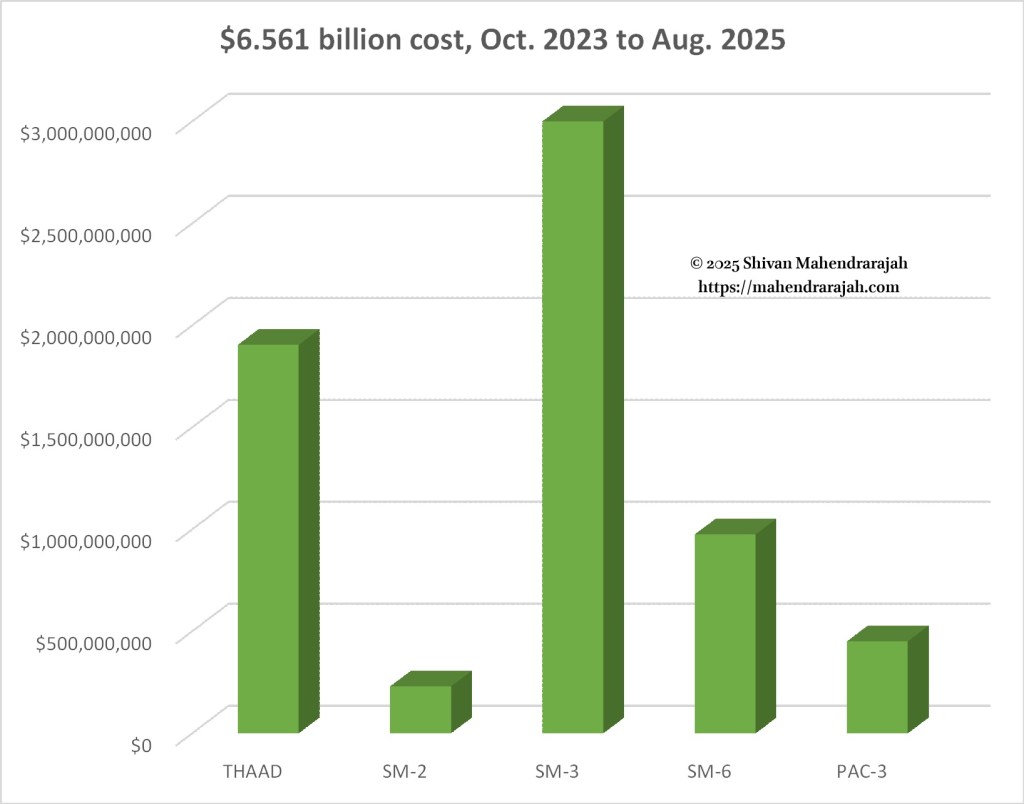
THAAD: 150 x $12.7 mil. = $1.905 bil.
SM-2: 100 × $2.3 million (average) = $230 mil.
SM-3: 150 × $20 million (average) = $3 bil.
SM-6: 150 × $6.5 million (average) = $975 mil.
PAC-3: $451 mil. PAC-3 CRI and PAC-3 MSE variants range in cost, from $3.4 to $5.17 mil. Since usage mix is unknown, 50/50 CRI/MSE split of 110 units (midpoint of 70–150 usage range) is assumed. Cost ranges, $287–615 million; hence the average, $451 mil.
Stockpiles
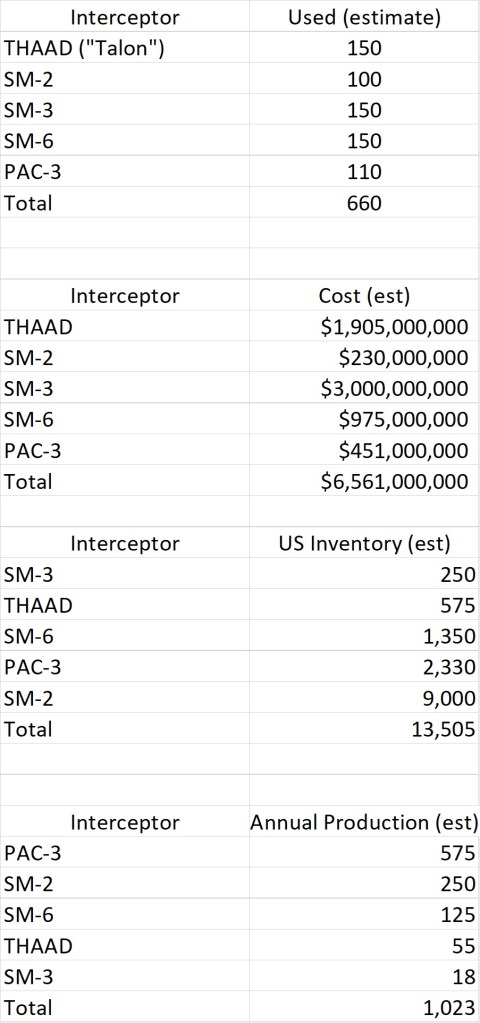
Apart from THAAD, where sources agree that 150 “Talon” interceptors were used, the SM-2, SM-3, and SM-6 mix of ≈ 400 interceptors used is unclear. I assumed the 100/150/150 split. But as noted above, one report has the SM-2/SM-3/SM-6 split at 268/159/280.
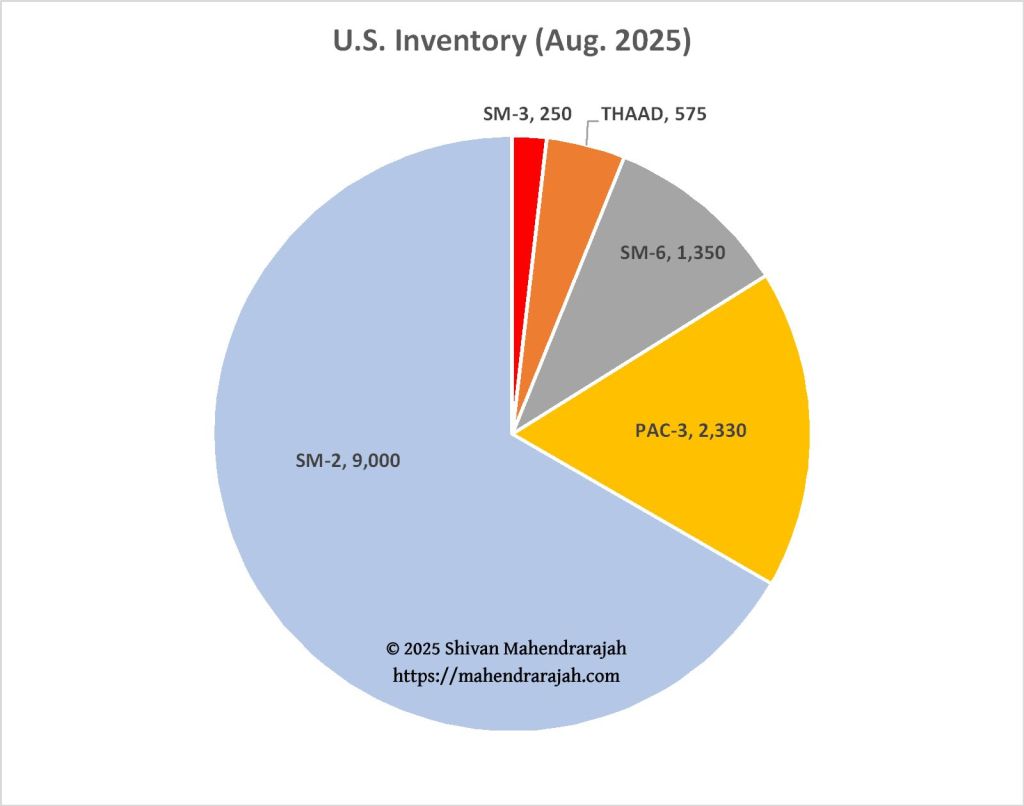
THAAD: 150 used; ≈ 575 remaining. This is assuredly high; sundry reports claim that 150 interceptors were used in the Twelve Day War reducing U.S. inventory by 25%. If 150 and 25% are both correct, then 600–150 = 450 Talons in stock.
SM-2: 100 used; 9,000 remaining.
SM-3: 150 used; 250 remaining.
SM-6: 150 used; 1,350 remaining.
PAC-3: 110 used (midpoint of 70–150 estimate); 2,330 remaining. PAC-3 transfers to Ukraine in 2025 reduce U.S. stockpile totals, but are excluded from usage total.
Data & Charts
Last Word
The Iranian Defense Minister, Gen. Aziz Nasirzadeh, stated that if the Twelve Day War had continued for three more days, the U.S. would have been unable to stop a single ballistic missile. I do not think this is an exaggeration. THAAD, SM-3, SM-6, and PAC-3 interceptor stockpiles are deployed elsewhere to protect U.S. forces; there is a limit to how many can be allocated to defend Israel. One THAAD battery in UAE was just removed to Israel. How many more batteries can the U.S. send to Israel?
Round two is coming, possibly with a preemptive strike by Iran. It is increasingly likely that Iran will adopt nuclear deterrence; the U.S. seems to think so: on 20 August 2025, USAF WC-135R Constant Phoenix “nuke sniffer” was prowling in the Persian Gulf. If round two kicks off with Israel deterred from using its nukes, Israel will be in trouble.
 Perspectives
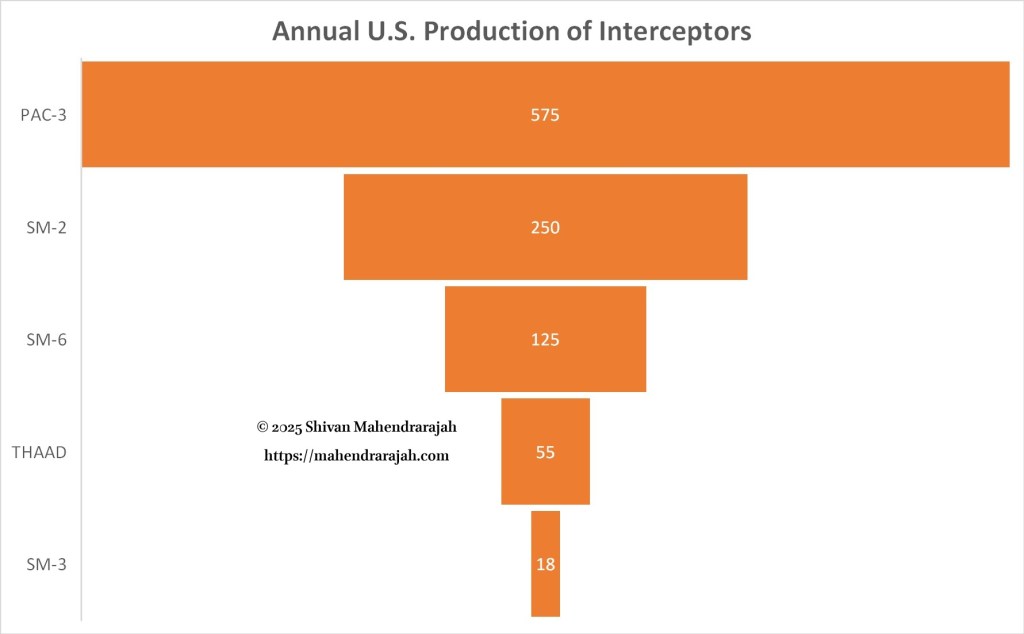
The US produces 95 THAAD missiles annually.
LikeLike
Varied numbers in public domain. Production for 2024, 11-12 Talons; 2025, 12, with plans to increase to 96; 2026, 24-144. The numbers used by me are conservative
LikeLike