The “collective west” pontificates about democracy, freedom, civil rights, and civil liberties in Iran, but Iran’s experiences (ca. 1860s to 1979) with foreign powers are of political domination and resource extraction. Organic democratic reforms in Iran were quashed by the west.
Western Powers & Iran
Iran has had unhappy experiences with western powers. Europeans began visiting and trading with Iran during the Safavid dynasy (1501–1722), but European influences became pernicious under the dissolute and bankrupt Qajar dynasts. A few lowlights.
1. “Iran for Sale”
Qajar dynasts (1796–1925) sold Iran piecemeal to foreign economic interests. Their attempts at selling Iran wholesale—Reuter Concession (1872) and Tobacco Concession (1890)—failed due to protests. The D’Arcy Concession (1901) led to the discovery of oil and creation of the Anglo-Persian Oil Company (1909–35; Anglo-Iranian Oil Company, “AIOC,” 1935–54).
2. Iran’s Constitutional Revolution (1905–11)
Disgusted with Qajar misrule, Iranians staged their first revolution of the 20th-century. An excellent account is in A Brief Narrative of Recent Events in Persia, followed by a translation of “The four pillars of the Persian constitution” (Luzac & Co. 1909) by Cambridge University’s eminent Persianist, E. G. Browne (d. 1926). The British, however, did not want Iranians to establish a constitutional monarchy could curb economic colonization. They bombed the movement out of existence—with an assist from Tsarist Russia. See E.G. Browne, The Reign of Terror at Tabriz: England’s Responsibility (Taylor, Garnett 1912).
3. Reza Pahlavi (1921–41)
Colonel Reza Khan of the Cossack Brigade staged a coup in 1921. In 1925, he abolished the Qajar dynasty and established the Pahlavi dynasty. He modernized Iran—building roads, railroads, schools, etc. As Prof. Abrahamian put it, “Iran entered the twentieth century with oxen and wooden ploughs. It exited with steel mills [and] a nuclear program.” But Pahlavi had an uneasy relationship with Perfidious Albion: he needed oil revenues paid to Iran by AIOC for his extensive modernization program, but his firm nationalism and independent streak unsettled Brits.
After the outbreak of WWII, Britain began making preparations to occupy Iran to extract—without contractual payment—oil resources. On 29 Dec 1940, BBC Persian was founded to propagandize against Pahlavi. (BBC Persian is now an outlet for propaganda against the Islamic Republic of Iran.) Once the Germans launched Operation Barbarossa (22 June 1941), fear of their capture of Soviet oil fields in the Caucasus gave birth to gestating British plans. Operation Countenance—invasion of neutral and independent Iran—began on 25 August 1941. Britain & USSR invaded, deposed Reza Shah, partitioned the country into occupation zones, and plundered oil and agricultural wealth. Millions of Iranians died from famine (see my essay, “Anglo-Soviet Occupation of Iran, 1941–46”).
4. Muhammad Reza Pahlavi (1941–79)
The malleable son ruled as Britain’s sock puppet. In 1951, the Iranian Parliament voted in favor of Muhammad Mosaddegh’s nationalization of AIOC. As the Iranian prime minister noted, Britain was a “cruel and imperialistic country” stealing from a “needy and naked people.” In retaliation, Britain instituted a global boycott of Iranian oil to starve it of cash (just as US sanctions today aim to punish Iranians). Plans were drawn for military action. Churchill, who had been unable to secure backing from President Truman, found support with the newly-elected Dwight D. Eisenhower. Operation Ajax—15 Aug 1953 coup, led by paid flunkies—removed Mosaddegh. The shah, who had fled to Italy, was escorted back to Tehran by CIA Director Allen Dulles. Mosaddegh suffered three years in solitary confinement, and died in 1967 while under house arrest.
Washington subsequently replaced Britain as the foreign power behind Pahlavi. He was Washington’s vassal; Iranians were sheep to be fleeced—oil and gas—to fatten American wallets. Legal and political statuses of Iranians under American occupation were described by Ayatollah Ruhollah Khomeini in a speech (27 Oct 1964):
Muhammad Reza Pahlavi’s secret police, SAVAK, was not just ruthless; it permeated every aspect of Iranian life. Informants in bazaars, schools, universities, offices, villages, and towns watched and listened. CIA’s Gary Schroen, who was based in Iran (before 1979), was so impressed by SAVAK that he used it as the model for the new Afghan intelligence service (in 2002, when Muhammad Arif Sarwari headed the nascent NDS).
5. Islamic Republic (1979–)
Iranians, disgusted with Pahlavi’s incompetence and vassalage, U.S. domination of Iran’s domestic and foreign affairs, and the ruthless exploitation of Iran’s resources, initiated the Second Revolution (1977–79). A broad and profound movement—a smorgasbord of political ideas (Marxists, democrats, Islamists, secularists)—that implicated every social-economic strata of society.
Irrespective of one’s views about the Islamic Republic, Tehran charted a course that aims to keep Iran independent of foreign domination and economic colonization. Khomeini’s goal on Iranian independence was expressed by the famous saying, “neither east nor west,” i.e., Iran did not intend to align with the NATO-bloc or Soviet-bloc; and intended to trade and associate with all nations. (Unilateral sanctions by the collective west have prevented Iran from functioning like a normal country.)
Iranian slogans about “imperialism,” “colonialism,” and “capitalism” are not rhetorical or necessarily Marxist: they reflect cumulative national experiences and historical memories over the past two centuries with imperialism and colonialism. Iran experienced a form of indirect colonial rule, where weak shahs (Qajars and Pahlavis) allowed foreign powers to run roughshod over Iranians and to extract Iran’s national wealth.
Conclusion
“Studying international law,” said a wag about the unprovoked US aggression against Venezuela and kidnapping of Nicholas Maduro, “is like studying dragon hunting.” The “Rules-based International Order”® has been dead for years. “Might makes right,” or “law of the jungle,” determine actions in the west. Russian officials were amused to watch UK and EU hypocrisy unfold in real-time: the same UK/EU officials that condemned Russia for “unprovoked aggression” and “violation of international law” were hemming-and-hawing about the US. This is expected from US’s vassal states. The UN refused to condemn the US for attacking Venezuela, or to condemn the US and Israel for attacking Iran.
Iran has experienced the west’s hypocrisy, and their abuses of the international entities created by the “Rules-based International Order.”® Two recent examples: (1) E3’s refused to honor its obligations under JCPOA, but triggered “snapback” despite E3’s lack of standing due to non-compliance; and (2) support for Israel and US’s aggression against the Iranian nation, and Israel’s murder of 1,100 Iranian civilians.
The “collective west” never insisted on democracy, freedom, civil rights, or civil liberties while Pahlavi was their man. The Revolutionary Guards were established by Khomeini because he knew how foreign powers ended the First Iranian Revolution; and what was done to Mosaddegh. The Guards exist to protect the Second Iranian Revolution.
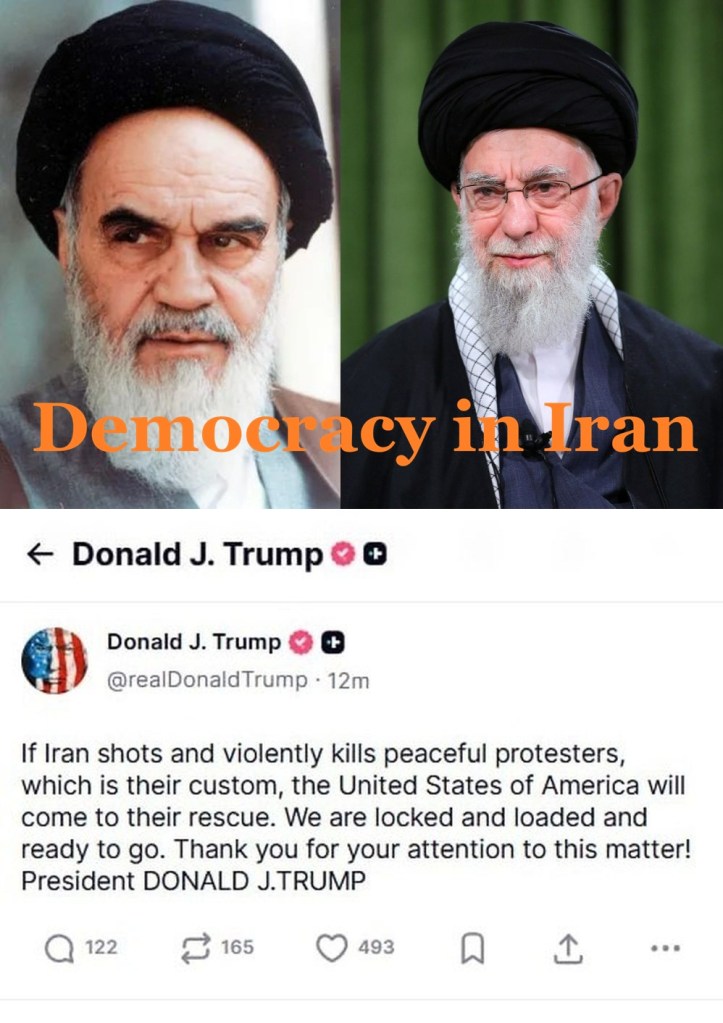
Given the sanctions, threats, agitators, and saboteurs over nearly five decades; Twelve-Day War; and Trump’s 3:00 a.m “drunk tweet” of 2 Jan 2026, in my opinion, Iranians will only be free of the west’s “democracy” projects through decisive conflict: wiping the Middle East board clean of US bases and bringing Israel to heel.
 Perspectives
You must be logged in to post a comment.