
Profits vs Science
Physicists have demonstrated scientifically that anti-ballistic missile (ABM) umbrellas have inherent weaknesses that render them largely ineffective. Critics have proffered scientific evidence, including documented failures of Patriot anti-ballistic missile defenses in the First Persian Gulf War, to support their findings. Rather than address critics, Washington officialdom has persecuted them; for example, MIT Prof. Theodore Postol.[1] Vast profits are available to manufacturers of ABM systems; hence the silencing of scientists. Iran and Russia are aware of ABM weaknesses, which is why they have invested extensively in penetrating air defenses through the use of electronic warfare, drones, cruise, ballistic, and hypersonic missiles. An overview of why ABM systems, and anti-rocket systems like Iron Dome, fail more often than not
Firstly, I recommend watching the 1 May 2024 interview with Prof Postol, “The Truth Behind Iran’s Missile Attack on Israel w/MIT Prof Ted Postol,” on LTC Daniel Davis’s show, Deep Dive with Daniel Davis.
First Persian Gulf War
Patriot missile defense systems had a horrible record in the First Persian Gulf War (1990–91). DOD briefing to Congress and White House claimed 89% success rate against Scuds launched at Saudi Arabia; 44% success against Scuds at Israel. Naturally, they were lying. An investigation concluded that “the best evidence indicated that the Patriot hit between zero and four of the 44 Scuds it engaged,” a rate from 0% to 9.09%.[2]
Viewers were subjected to videos on CNN, BBC, etc., of “successful” interceptions in the night skies over Saudi Arabia and Israel. However, the bright flashes from explosions were not from direct hits of Patriot (surface-to-air missile; SAM) interceptors against Scuds coming from Iraq, but from (a) proximity fuses as an interceptor neared the Scud or a component or fragment from a Scud; or (2) by the interceptor automatically self-destructing after missing a Scud or flying past a Scud. (SAM interceptors self-destruct, or the warhead will fall and cause harm on the ground.) Thus so the night of 13–14 April 2024 when IRGC successfully struck Israel. Lots of bright flares and explosions over the skies of Israel that signify nothing. On the success of the Iranian air raid, see my article, “Israeli air defenses are not ‘Untouchable’”; and by another, “Precision over power: How Iran’s ‘obsolete’ missiles penetrated Israel’s air defenses.”
The Problematique
Patriots (and other ABM) systems have markedly improved in the three decades since the First Persian Gulf War, but inherent problems remain: (1) the difficulty of hitting “on the nose” a warhead that is traveling at multiple times the speed of sound (the warhead must be struck and neutralized or it will explode on impact with the surface); (2) difficulty of hitting a missile that is not traveling in a predictable trajectory (Scuds had unpredictable accelerations and movements that led to interceptors missing them); (3) difficulty in differentiating between the missile’s booster (which separates once fuel tanks are emptied), the warhead, and decoys (of which there are many types that are deployed precisely to confuse air defense systems); and (4) difficulty in hitting warheads that are designed to evade interceptors by maneuvering in flight. These warheads are called “Maneuverable Re-entry Vehicles” (MaRV).
Three examples of Iranian MaRV strikes on Nevatim Airbase, Israel, 14 April 2024. Watch the movement of the warheads. The missile is presumably the Khybar-Shekan (model 1), which has been in service for about two years (Khyber-Shekan-2 is much better). KS-1 is the only recent model used; the rest of the missiles were old stock: 20, 10, and 5 years old—spring cleaning by IRGC! Not exactly a joke: IRGC has so many modern missiles in stock that they are trying to flog older models to Russia and other buyers. IRGC also no longer manufactures point-to-point missiles, i.e., missiles with fixed trajectories, but rather, MaRV models. Hence the need to dispose of old stock.
Selling False Security
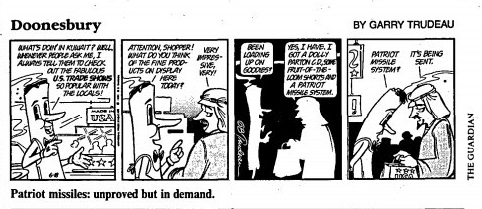
The cartoon tells the story. Patriot missile systems are popular items on national shopping lists, especially for Gulf Arab states flush with petro-dollars. Thus so for air defense systems built by Israel (Iron Dome, Arrow, David’s Sling) and NATO countries. Despite technological improvements since the First Gulf War, Patriots and other air defense systems are essentially worthless against hypersonic missiles, hypersonic glide vehicles, and ballistic missiles with MaRV warheads. Hence IDF’s decision two weeks after IRGC’s successful strike to mothball its Patriots. The Patriots will probably be sent to Ukraine where they will join Russia’s NATO scrap metal junkyard. Iron Dome, which is part of Israel’s “integrated air defense,” is designed to intercept rockets (not missiles). Iron Dome has a low success rate against artillery rockets (short range projectiles, 10-20 km), which is at best “4 or 5 percent,”[3]. If Iron Dome cannot handle rockets built by Hamas, it cannot intercept the higher quality missiles and rockets available to Hizballah. Iron Dome has zero capability against Iranian ballistic missiles.
Conclusions
IDF has 72-hour warning before IRGC launched its air raid, and even here, IRGC used slow-moving drones to signal the start of the retaliation. Israel and its Allies had time to launch about 200 aircraft to deal with the drones, leaving Israeli ABM to deal with the incoming cruise and ballistic missiles. Still, IRGC hit their targets. Meanwhile, IDF expended (by their estimate) $1,300,000,000 worth of interceptors. If each interceptor costs $2,000,000, IDF fired 650 SAMs to target 30–40 missiles (or, say, 50–60 missiles) and scores of drones. It is worth keeping in mind that about 100 drones were shot down by Allied fighter jets; and U.S. interceptors were also launched, but had dismal success. Next time, IDF will not have warning and IRGC will use the best weapons in its arsenal.
[1] W.J. Broad, “Investigation of Patriot Missile Critic Angers Him,” New York Times (19 March 1992).
[2] See also, “Patriot’s Scud Busting Record is Challenged,” Science, vol. 252 (3 May 1991), pp. 640–41; Marc S. Miller, “Patriotic Blindness and Anti-truth Weapons,” Index on Censorship 10/1991, pp. 32–34; Theodore Postol, “Lessons of the Gulf War Experience with Patriot,” International Security, vol. 16, no. 3 (Winter, 1991–92), pp. 119–171.
[3] H. Bray, “Israel’s Iron Dome system doesn’t work, says scientist,” Boston Globe (17 October 2023).
 Perspectives
You must be logged in to post a comment.