Installation of a new administration should be occasion for evaluation of foreign policy and for adjustments, but Marco Rubio’s statements about the Taliban portend enhanced misery for 42 million Afghans suffering under the Islamic Emirate. Influence of Afghan émigré groups, viz., “National Resistance Front,” will prevent the Trump Administration from forging a diplomatic path to Kabul that enhances U.S. National Security.

Diplomacy with the Taliban
Marco Rubio is intellectually and temperamentally unsuited to be Secretary of State. He was an empty vessel when he was elected Senator in 2010. The container was filled with pro-Israel and anti-Russia, anti-China, and anti-Iran nonsense by Evangelicals, Israelis, and neoconservatives. Rubio is sanctioned by China, which means he cannot visit Beijing even as SECSTATE.
On 25 Jan 2025, on hearing that the Taliban may be holding American hostages, instead of confirming this to be fact, and then talking to the Taliban, Rubio began his “dialog” with the Islamic Emirate by issuing threats on Twitter: “if this is true, we will have to immediately place a VERY BIG bounty on their top leaders…”
Diplomacy with the Taliban is essential to staunch the flow of refugees from Afghanistan, to improve the Afghan economy such that it delivers economic benefits to Afghans; and to allow CIA’s Kabul Station and NSA listening post (both housed in the U.S. Embassy) to re-open. Contrary to claims by Afghan émigré groups, Taliban, AQ, and ISIS-K pose minimal risks to U.S. National Security.
It behooves the U.S. to offer the Taliban limited economic benefits and limited sanctions relief, and to thwart the insurgent activities of the National Resistance Front (NRF). De-stabilization of Afghanistan through impoverishment, famine, violence, and international isolation benefits no one, least of all millions of Afghans. The Taliban’s “gender apartheid” policies are awful, but the Emirate is unlikely to shift its position on such a fundamental pillar of their “Islamic” policies. But if the Taliban regime de-stabilizes, radical actors like ISIS-K will become stronger. That is more dangerous for U.S. National Security than the Taliban. TB has never expressed intent to conduct external terrorism in the U.S. It is focused on creating its vision of the “perfect” Islamic state. Avoidance of factionalism and civil war should also be a consideration for policymakers in Washington.
Minimal National Security Threats
The CENTCOM commander, Michael Kurilla, stated in Congressional testimony on 7 March 2024, that while ISIS-K has the ability to strike in Eurasia—areas that border Afghanistan—they do not currently possess the ability to strike in North America. In testimony in Feb. 2022, in response to a Senator’s question, Kurilla said:
Q: In your view, can the United States conduct effective “over the horizon” counterterrorism operations in Afghanistan without a partner force on the ground? Please explain your answer.
A: Over-the-Horizon-Counterterrorism (OTH-CT) operations are, in my experience, difficult but not impossible. Though a partner force on the ground significantly improves the effectiveness of counterterror operations, OTH-CT has many benefits. Most critically, through employment of airborne intelligence, surveillance, and reconnaissance (ISR) assets, OTH-CT allows us the ability to degrade terrorist groups that pose a direct threat to the United States and our allies in places in which we lack physical access.
—Kurilla (Feb 2022)
“Physical Access” to Afghanistan
The U.S. Government constructed a massive embassy in Kabul that is vacant. The facility is not just for diplomats, but houses the CIA’s Kabul Station and NSA electronic equipment. The geographic location of NSA’s Kabul post makes it valuable. There are NSA posts in U.S. embassies in Central Asia and Pakistan, but a functioning post in Kabul will be benficial.
If the U.S. establishes cordial ties with the Islamic Emirate and re-opens the U.S. Embassy, CIA officers can return to doing what CIA field officers are trained to do: cultivating relationships with locals, including Afghan government officials, and developing sources of HUMINT, while NSA returns to the business of vacuuming electronic intelligence. Intelligence independently developed on the ground by case officers, and in partnership with the Islamic Emirate and Pakistani ISI, will complement the aerial ISR (drones and satellites) upon which the U.S. currently relies.
A report published in 2023 in CTC Sentinel (journal of the Counterterrorism Center, U.S. Military Academy, West Point), assessed that “the terrorism threat will likely increase under a weaker Taliban regime.” The report noted that OTH-CT strikes have flatlined since the assassination of AQ leader, al-Zawahiri (2022). This is likely due to the dearth of sound intelligence from Afghanistan.
Émigré Politics
Émigré politics have skewed U.S. foreign policies in multiple arenas in the decades since WWII ended. Émigrés live comfortably in the west—EU, UK, North America, Australia, New Zealand—and advocate for policies that cause immense suffering for the people they abandoned. Iranian monarchists (Reza Pahlavi, son of the deposed Shah), live comfortably in their “Tehrangelese” mansions and support “maximum pressure” sanctions that make life miserable for 90 million Iranians. Furthermore, Iranian monarchists and certain factions favor U.S.-led war against Iran that has the potential to kill, maim, and displace millions of Iranians. They have joined forces with Israel and neoconservatives in war-mongering against Iran. After their policies cause suffering and death, monarchists expect to return to Iran and rule the people they harmed! Ahmad Chalabi and Iraq War are an example of émigrés selling a war to Washington that directly led to the deaths of tens of thousands of people.
Afghan Émigrés
Afghan émigrés have done their share of damage to U.S. foreign policy. Even before Operation Enduring Freedom commenced on 7 October 2001, Afghan émigrés from the Pashtun ethno-linguistic group, like Ashraf Ghani and Zalmay Khalilzad, plotted with the Bush Administration and UN (viz., Lakhdar Brahimi, UN Special Rep for AFG) to seize control of Afghanistan from the Tajik, Turk, and Hazara mujahidin fighting the Taliban. Pashtun émigrés then wrote a constitution that deliberately stripped all other ethno-linguistic communities of power in post-2001/02 Afghanistan. Twenty years, tens of thousands of lives, and trillions of dollars expended to implement an ethno-linguistic project that was destined to fail. The ethno-linguistic war continues: Tajik keyboard warriors battle Pashtun keyboard warriors about language (Pashto vs. Dari), cricket, and other irrelevancies.
NRF and Ahmad Massoud, like Karzai, Ghani, Khalilzad, et al., are selling “snake oil” to Americans: support NRF in its armed struggle against the Taliban, the salesmen say, and we’ll make Afghanistan democratic, multi-cultural, gender neutral, and safe. This is hogwash. NRF exaggerates the terrorist threats from the Islamic Emirate. NRF, like the Iranian terrorist organization, Mujahidin-e Khalq (MeK or MKO) and monarchists, pitch their sales to neoconservatives: neocons see terrorists under every bed, and never oppose a war, especially since neocons don’t fight the wars they start.
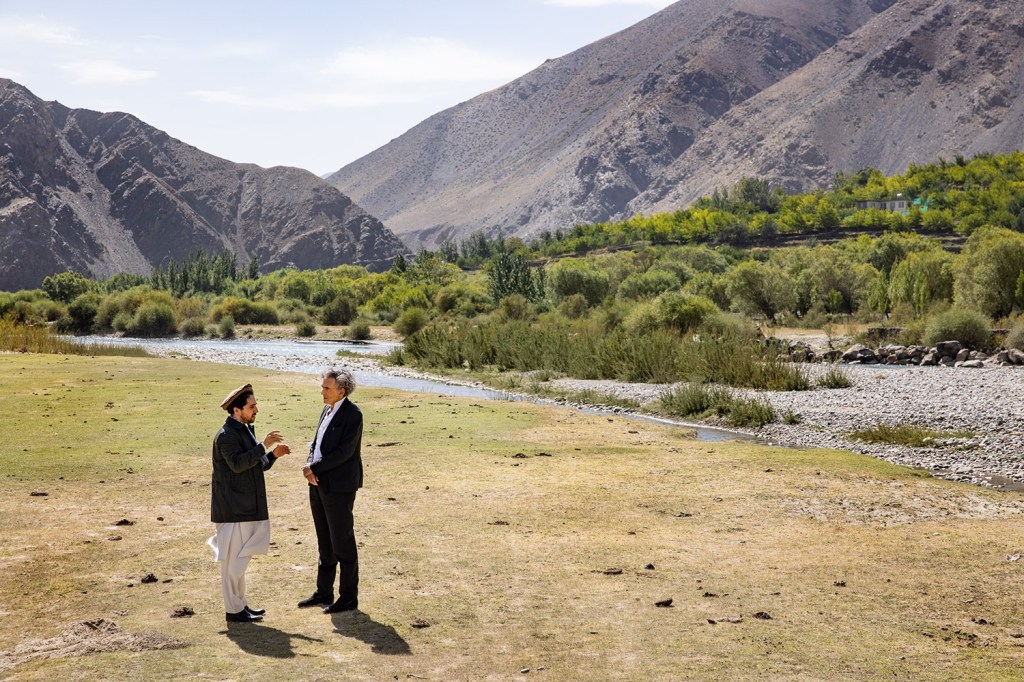
If one reviews tweets by Ahmad Massoud and Ali Nazary (head of foreign policy for NRF), a troubling pattern emerges: zero tweets in support of Palestine, or condemnation of the fifteen-month genocide in Occupied Palestine, or of Israel or Washington. NRF failed to condole with Tehran on the deaths of Iran’s president and foreign minister in May 2024, despite Iran being an important neighbor and host to about one million Afghan refugees, the majority of whom are Tajiks or Hazaras. However, there are plenty of tweets showing Massoud and/or Nazary hobnobbing with American neocons. NRF has allied with arch-Zionist, Bernard-Henri Lévy, who played a role in the Libya War (2011), and who supports Massoud and NRF. Like Mujahidin-e Khalq and Iranian monarchists, NRF has allied with Zionists and American neoconservatives. This bodes ill for U.S. foreign policy.
Afghan Factionalism and Instability
Over the twenty-year international presence in Afghanistan, Tajiks, Turks, Hazaras, etc. were utterly incapable of agreeing even on fielding a single candidate to challenge Hamid Karzai or Ashraf Ghani. If, hypothetically, Afghan émigré organizations secure power in Afghanistan, Afghans will return to their favorite sports of factionalism and sectarianism.
Furthermore, since Massoud was educated at King’s College London and Sandhurst Military Academy; and Massoud and Nazary have hitched their wagons to the neocon horse, they are distrusted by Iran, Russia, China, and Pakistan. For the moment, NRF is treated by Russia, China, Iran, and Pakistan as a nuisance, akin to mosquitos—and not the dangerous dengue- or malaria-bearing type. But should NRF acquire power, neighbors will turn against it. One form of instability in Afghanistan (Islamic Emirate) will be replaced by another form of instability (NRF/émigré).
Cuban Model in Afghanistan?
It is unlikely that NRF will acquire power, but their associations with neocons guarantees them the ability to influence policy in the Trump Administration. They will oppose the lifting of any sanctions or delivery of economic relief. Cuba is an example of what NRF and Afghan émigrés have on the menu for Afghanistan. After Fulgencio Batista was toppled by Castro (31 Dec 1958), Cuban émigrés pushed anti-Communist policies in the U.S. Congress and White House, which, in the context of the Cold War (“Reds under the bed”), found support. Sanctions followed. Now, 67 years later, Fidel Castro is dead; the original anti-Castro émigrés are dead; the Cuban regime clings on, but millions of Cubans live in abject misery due to old sanctions. The world has moved from the Cold War, but the U.S. is “stuck on stupid.” If the Taliban are not offered limited sanctions relief and economic support, and international aid does not flow freely, Afghanistan is at risk of becoming the next Cuba.
Sanctions and Refugees
War, of course, leads to refugees, as witnessed recently with Afghanistan, Iraq, Syria, Libya, Somalia, and Palestine. Sanctions lead to higher rates of emigration (outflows). This has been demonstrated by empirical studies. Sanctions create economic crises that spur refugee outflows. Venezuela: hundreds of thousands have fled, many to the U.S.; Cuba: about one million refugees live in the U.S. Iraq, under sanctions from 1991–2003, and Iran (1990s to present), experienced large-scale emigrations.
There are about one million Afghan refugees in Iran, 1.5 million in Pakistan. Conditions in Afghanistan must be improved such that they can return. Trump just embargoed 10,000 Afghan refugees from traveling to the U.S., but has not signaled that he will lift any sanctions or otherwise help improve Afghanistan’s economy. If that were done, fewer Afghans would feel the need to flee overseas. While some Afghans genuinely fear reprisals by the Taliban, the majority are economic refugees.
Prescriptions
NRF and Afghan émigrés can rest easy. Donald Trump and Marco Rubio will not take advice from me!
NRF and Ahmad Massoud are not viable partners for the United States. Arming them will create more animosity between the U.S. and the Islamic Emirate. Moreover, since Afghanistan is landlocked, U.S. military support will have negligible impact absent material support from neighboring states. NRF should be marginalized by Washington. Let NRF organize conferences, etc., and fight battles online, but NRF must not be allowed to shape U.S. foreign policy.
In 1993, Bill Clinton began normalizing relations with Vietnam. This was a major risk for him since he was a Vietnam War “draft dodger,” but to his immense credit, he took the risk. In 1995, Veterans of Foreign Wars endorsed his “normalization” process. Trump and Rubio should talk to the Taliban, re-open the U.S. Embassy to allow NSA and CIA to return to their business; lift some sanctions but hold others in abeyance pending “good behavior” by the Taliban; and develop cooperative arrangements with the Islamic Emirate. Washington and Kabul have more in common than not.
Also unlikely to happen, but necessary, is for Rubio to talk with Iran, Russia, and China about security threats in Afghanistan. The three have concerns about Afghanistan, specifically, AQ and ISIS-K. Again, Beijing, Moscow, and Tehran have common ground with Washington, but a zealous neoconservative like Rubio will be incapable of comprehending the importance of diplomacy and cooperation.

The issue of gender apartheid under the Islamic Emirate is not being ignored by me; but if the Afghan economy improves consequent to foreign investments, sanctions relief, and international aid efforts, then some of the misery being experienced by Afghans will be alleviated.
 Perspectives
You must be logged in to post a comment.