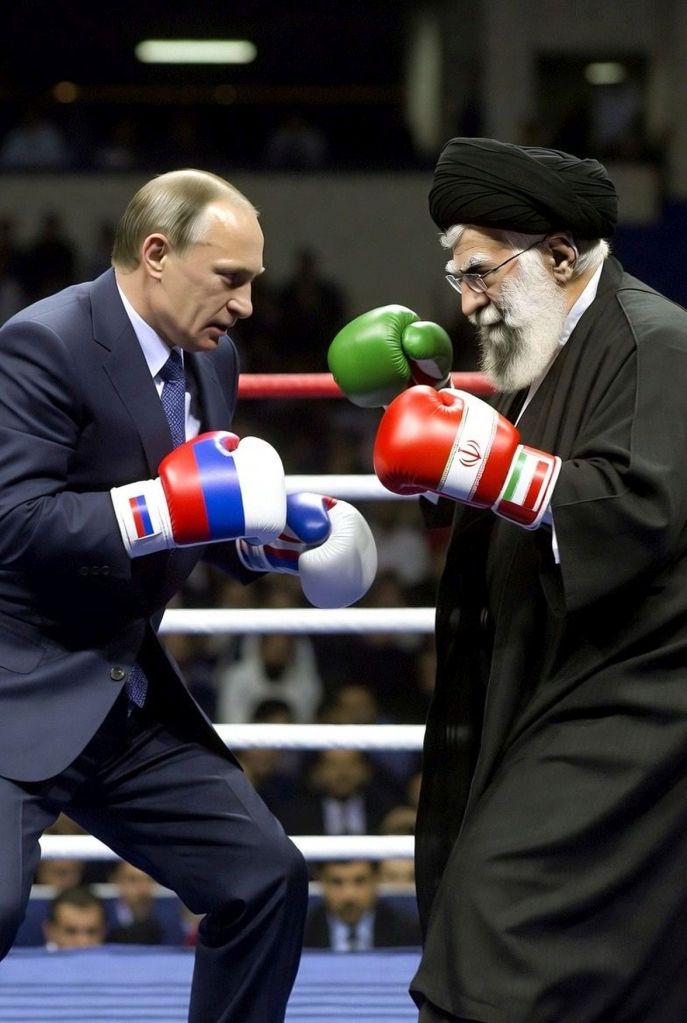
Recently-declassified meeting memoranda reveal Putin’s worrisome opinions of Iran: “rogue state,” “they’re quite nuts,” “they are not primitive people: it was quite a surprise to me.” Putin plots with Bush to curtail Iran’s uranium enrichment; and raises with Bush the possibility of military strikes on Iran: “Then we need to do something. What? Strike?” By “we” does Putin mean joint US-Russian strikes?
Introduction
Three unique MEMCONs (“memorandum of a meeting conversation”) were released by the U.S. Gov. on 23 December 2025 pursuant to FOIA demand (see the National Security Archive, George Washington University). I have uploaded the files and highlighted passages—not all highlighted text is quoted. Annotations are included in the PDFs.
I focus on Iran. Putin’s views on China, North Korea, Ukraine, and NATO will be of interest to other scholars. Putin’s pro-US/EU stances and ambition to integrate with the west (“ally” with US) should trouble Iran. Today, despite the Ukraine War and rampant Russophobia in UK/EU, Putin remains an Europhile:
Putin: If we were to join our efforts—Russia and European countries—our joint GDP would be higher than the US.
Russian Commentators: Incurable Europhilia. There is not a single government official in the entire EU who loves Europe as much as Putin. It’s not even close.
—Russians with Attitude, Twitter, 19 Dec 2025—
Armchair Warlord (Twitter): “How many times have I said that if they’d bribed him with EU membership, Putin would have been leading Moscow Pride on Red Square two years later?” AW earlier noted that “Putin is a neoliberal Europhile”; and “Putin was practically begging for a seat at the European table…”
Putin’s “incurable Europhilia” (Russian Westoxification?) is manifest in comments on NATO membership, down to referencing USSR’s 1954 NATO application. He wants to “ally” with the west; only “dire need” would compel Russia to ally with other nations (his views of China are negative; he sees PRC as a threat). MEMCONs show that in 2001, Putin is “drunk on the west” (Westoxified) unaware that NATO requires an enemy—USSR or Russia—for its raison d’être. By 2008, Putin’s words start to reflect reality.
Westoxification (gharbzadegi)
… the fascination with and dependence upon the West to the detriment of traditional, historical, and cultural ties to Islam and Islamic world. Defined as an indiscriminate borrowing from and imitation of the West, joining the twin dangers of cultural imperialism and political domination…
—Oxford Reference—
Since the Ukraine War, Putin has been “mugged by reality.” However, while Iran-Russia relations have improved since 2022, Putin’s “incurable Europhilia”; Kremlin’s ongoing talks with the White House; and Putin’s cordial relationship with Trump, lend weight to Iranian qualms that Russia may downgrade economic-military links with Iran for relief from US sanctions, particularly if Israel insists on a downgrade. Only “dire need” compelled Russia to ally with China and Iran. What happens if Russia’s need is not “dire”? Putin’s contempt for Iran and its hierocracy—albeit from 2008—may concern Tehran. Putin’s impressions of Iran, however, were formed at a meeting with Mahmoud Ahmadinejad in 2007.
Another concern for Iranians is Putin’s support for Israel. Putin implies that his support for Israel is robust, but falls short of conversion: “If they need me to have a circumcision, that I can’t do.” (This is not in the published documents.)
The Three MEMCONs
1. 16 June 2001
Bush: “I’m concerned by Iran. Weapons reaching that country could harm you [Russia], too. I can’t do much with them [Iran] now. . . Russia belongs to the West; it is not an enemy. In 50 years, China could become a big problem. Russia’s interests lie with the West…”

Putin: “Regarding rogue states [Iran]: we have a complex history with Iran. History is important...”

Bush: “We must learn to move past it. We’re the ones writing history.”

Putin: “I will restrict missile technology to Iran. There are those [in Russia] who want to make money with this country [Iran] in these areas. . . Iranian experts do pose many questions about sensitive matters to our experts. There is no doubt they want a nuclear weapon. I’ve told our people not to tell them such things.”
2. 16 Sep 2005
See highlighted sections of pages 2–5 on Iran’s nuclear program; side meetings between FM Sergei Lavrov and SECSTATE Condi Rice re Iran and its nuclear program (details are not in the MEMCON); possibility of referring Iran to the UNSC; Putin’s meeting with Ahmadinejad and “uneasy conversation” with him.
But on the possibility of military strikes on Iran’s nuclear facilities, note Putin’s repeated use of the first-person plurals: “we” and “our.” Is Putin here considering or suggesting joint US-Russian strikes on Iran? Rhetorical? 🤔
Then we need to do something. What? Strike? Who does that? Where? What targets? Are you sure of the information you have? It’s important that we build a basis for our position.
—MEMCON, p. 3 (emphasis added)—
3. 6 April 2008
Putin: “Everything is under control there. Sometimes there are instances of cooperation [Iranians are] trying to pursue in a clandestine manner that’s not apparent to the [Russian] government. We will find them [Russian cooperators] and they will be punished.”

Bush: “Where is this being done?”

Condi Rice: “Arak [nuclear site, Iran]”

Putin: “There are people [Russians] willing to earn a bit of money on this, but we identify those cases.”

Bush: “I tell people on Iran, your [Putin’s] plan was very ingenious. [Iranian] leaders say they want civilian nuclear power, we say, ‘Fine, that’s your right;’ [but] Russia says, ‘Here’s the fuel, therefore you don’t need to enrich. If you do it shows you don’t want civil nuclear power, you want more.’ People say, ‘Can you work with Putin? I say, ‘Here’s the example. He [Putin] took the lead on Iran and I followed.’ It was the right thing to do.”

Putin: “That’s what I told them. In Iran when they said they were building a new nuclear power plant, and they needed fuel. I asked when would they complete the plant. It’s a long-term project. We've been building Busher for 15 years. I said, ‘You won’t complete a new plant for 15 years, so why are you building up enrichment now?”

Bush: “You and I had a conversation about the S-300 and you said you’d wait to see how they behave—a conditional sale, and I appreciate that.”

Putin: “We have a contract with them [for S-300 SAM systems] signed four years ago but not being implemented.”

Bush: “I appreciate that. They’re nutty.”

Putin: “They’re quite nuts.”

Bush: Expresses hopes for new leadership in Iran.

Putin: “What surprised me when I was there, they may be crazy in their ideology but they’re intellectuals. They are educated in university, come from an academic environment, including Ahmadinejad, his entourage, the Speaker of parliament. They are not primitive people. It was quite a surprise to me.”
Analyses
Nutty Iran: Putin’s impressions of Iran were shaped by his encounters with Mahmoud Ahmadinejad (president, 2005–13) and his entourage. In the lead to the June 2009 election, and protests that followed, Iranians expressed negative views of Ahmadinejad, viz., that he presented the world with a dreadful public face for Iran: simian, unkempt, and ignorant. A viral chant by protestors reflected their disdain:
یه هفته، دو هفته، محمود حموم نرفته
Transliteration: “ay hafte, do hafte, Mahmoud hammoom na rafte”
Loose translation: “[It’s been] a week [or] two since Mahmoud [took a shower]”
Vladimir Putin returned to Iran in 2015, 2017, 2018, and 2022; and met Iranian presidents at international events. Presidents were Hassan Rouhani (2013–21) and Ebrahim Raisi (2021–24), educated and distinguished men. He met Masoud Pezeshkian—an eminent cardiac surgeon—in 2025 for the signing of the Iran-Russia cooperation Agreement. In 2022, Putin met with the erudite and affable Ayatollah Khamenei. Putin’s opinions of Iranians have assuredly improved.
Russia’s Uranium Hustle: This is concerning. Bush’s comment: “Russia says, ‘here’s the fuel, therefore you don’t need to enrich’. . . People say, ‘can you work with Putin?’ I say, ‘here’s the example. He took the lead on Iran…’” (MEMCON, 6 April 2008, p. 8). Russia denied Iran the right to enrich and acquire scientific know-how, but Ayatollah Khamenei insisted that Iranian scientists master the nuclear cycle, “from the uranium mine to the nuclear reactor.” Thousands of Iranian scientists have since been trained in every aspect of civil and military nuclear sciences.
By 2015, Iran had stockpiled ca. 11,000 kg (ca. 25,000 lb.) of low-enriched uranium (LEU). Enter JCPOA, which required Iran to ship all but 300kg of 3.67% LEU to Russia. This it did on 28 Dec 2015. Iran received in exchange 140 MT of natural uranium (yellowcake) from Russia and 60 MT from Kazakhstan. After Tehran shipped its uranium, and JCPOA came into effect (Jan. 2016), Obama advised American businesses not to invest in Iran. Russian investments in Iran post-JCPOA were negligible (cf. China, estimated $600 billion). Russia stalled work on the INSTC Corridor—until after 2022, when Russia had “dire need” for Iran.
JCPOA’s “Snapback” provision, according to US nuclear negotiator, Wendy Sherman, was a Russian innovation: “Russian foreign minister Lavrov helped devise an ingenious solution by which any P5+1 member could demand a vote in the Security Council if it is believed that Iran was in violation of the deal.” In 2025, Lavrov denied the claim, shifting blame for the “Snapback” clause on Iranian FM Javad Zarif.
1. Did Putin collude with Obama to deprive Iran of its enriched Uranium through JCPOA? See MEMCON, 6 April 2008, p. 8, re collusion with Bush.

2. In 2024 and 2025, Putin proposed that Iran transfer 440kg of 60% “Highly-Enriched Uranium” (HEU) to Russia to secure a new “nuclear deal” with the US (Iran rejected the proposal). Is Russia still trying to deny Iran enrichment and HEU/LEU stockpiles?

3. Does Russia fear an Iranian nuclear weapon? See MEMCON, 16 Sep 2005, p. 5, about Putin being as “nervous” as Bush about Iran’s nuclear program.
Bad Faith re S-300 Contract: On the S-300, Putin said to Bush, “We have a contract with them [Iran] signed four years ago but not being implemented” (MEMCON, 6 April 2008, p. 8). Iran sued Russia. President Dmitry Medvedev (2008–12) annulled the contract in 2010.
Russia’s policy reversal may have been contingent upon improving relations between Moscow and Washington, insofar as it occurred on the same day that the White House announced a June 24, 2010 summit meeting between presidents Barack Obama and Dmitri Medvedev, to be held in Washington
—Eric Moore, Russia-Iran Relations Since the End of the Cold War, New York, 2014, 38—
Iran is experiencing the same foot-dragging by Russia w.r.t. to Su-35 jet fighter deliveries (see “Iran-Russia Relations: Iran’s Su–35 Saga”). “Improving relations between Moscow and Washington” is just what Trump and Putin are trying to do right now (29 Dec 2025).
Is Russia stalling on contractual obligations to secure benefits from the US? Israel is America’s “baby,” and the “baby” gets whatever it wants. What it wants is for Iran not to have Su-35 fighters. Tel Aviv is making a fuss about Saudi Arabia acquiring watered-down F-35 fighters. What sort of fuss is Israel making behind the scenes with the White House and Kremlin about Su-35 fighter jets? The jets are undoubtedly one of the Kremlin’s bargaining chips.
Conclusion
Putin: “we have a complex history with Iran” (MEMCON, 16 June 2001, p.3). Indeed. Setting aside 19th-century conflicts between the Russian Empire and Iran’s Qajar shahs, the 20th-century witnessed exceptionally difficult periods in Russian-Iranian relations: (1) Tsarist Russia colluded with Britain to violently quash Iran’s 1905–11 Constitutional Revolution,1 and committed sacrileges by bombing the shrine-complex of Imam Reza in Mashhad, a site holy to Shia and Sunni; (2) Stalin colluded with Churchill to invade, partition, and plunder Iran (see “Anglo-Soviet Occupation of Iran, 1941–46”); and (3), the USSR joined the US, UK, France, and Gulf Arab states in arming Saddam Hussein during the Iran-Iraq War (1980–88). This history has heightened Iranian suspicions of Russia, viz., the Kremlin’s willingness to ally with its Anglo-American rivals against Iran. The MEMCONs prove that Putin colluded with Bush vis-à-vis Iran’s nuclear program and S-300 contract. Putin may have colluded with Obama to remove ca. 11,000 kg of LEU uranium from Iran. This is just a suspicion based on Putin’s past actions, and desire to secure benefits from the US.
Ayatollah Khomeini (d. 1989) instituted a policy of “neither east nor west,” meaning, Iran did not intend to ally with the NATO-bloc or Soviet-bloc, and sought to trade and associate with both east and west. However, US/EU/UK sanctions and betrayals forced Iran to choose east; hence, China, BRICS+, and SCO. China was a steadfast ally during the Iran-Iraq War; and PLA aided Iran in the Twelve-Day War (see “China’s Eyes, Iran’s Fist: PLA’s Satellites & IRGC’s ‘Kill Chain’”). Iran-China economic, cultural, and scientific-technological exchanges date to antiquity. Both venerable and refined civilizations are natural partners.
Russia turned east—China and Iran—from “dire need” (sanctions and ostracism in 2022). A “shotgun wedding.” Putin continues to look west, possibly hoping for re-integration, just as Iran’s Reformists look west. Reformists, despite being kicked and abused by US/EU on daily basis, wag tails and crawl to US/EU for pats and scraps.
Russian military support for Iran is hazy; a bit like Yeti sightings—excitedly talked about by analysts but with negligible visual evidence. Su-35 deliveries would prove that Putin is not double-dealing—as he did with the S-300 contract.2
Until then, questions remain: Is Putin “all in” with Iran? Will Moscow end its “shotgun wedding” in exchange for “cash-and-prizes” from Washington? Time will tell.
- The Islamic Revolutionary Guards Corps (IRGC) was created in 1979 to prevent foreign powers from reversing the Second Iranian Revolution (1977–79), just as the British and Russians overturned the First Iranian Revolution (1905–11). The 1953 Anglo-American coup against Mohammad Mosaddegh was another motivating factor. ↩︎
- Iranians are naïve. After the S-300 debacle, Tehran should never have trusted Russia. Air defense systems and fighter jets should have been purchased from China. As I have often said, China plays the “long game,” and sees Iran as indispensable to its regional and global ambitions; Beijing does not give a “rat’s tookus” about being loved by the US or EU; and China has no Zionist lobby or Jewish population. ↩︎
 Perspectives
You must be logged in to post a comment.