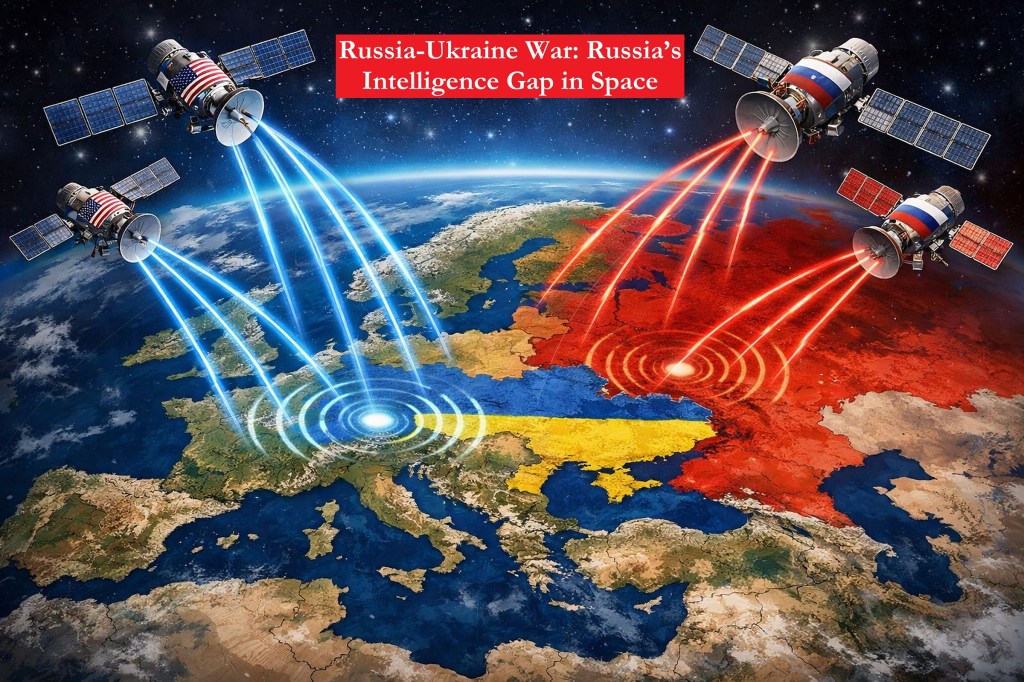
Elon Musk’s shutdown of Starlink prompted me to as ask, “why are Russian soldiers using Starlink? Don’t they have satellite-based comms?” Yes and no. Russia has systems for “Command, Control, and Communications (C3), but no satellite-based network comparable to USA’s and China’s prolific and multifaceted networks used for C3 and ISR.
Introduction
I explore Russia’s “Low-Earth Orbit” (LEO) sats w.r.t “Integrated ISR” (defined below). LEO sats are used for, inter alia, Starlink. Russia’s C3 systems and impacts (if any) of whitelisting are outside the scope. Terminology: satellite classes, orbits, ISR models, etc. are at this link.

Integrated ISR
Integrated ISR refers to the seamless fusion of “Intelligence, Surveillance, Reconnaissance” (ISR) across multiple sensors (different types of “eyes and ears”); platforms (sats, UAV, aircraft and ships equipped to gather electronic intelligence, ground stations, etc.); and domains (space, air, sea, ground, cyber) to develop a real-time picture for decision-making.
Russia is weak in the space domain; years behind China and USA. It is rushing to catch up, but every program is delayed and ambitions scaled back.
Russia’s LEO network for ISR & C3
Strela-3M (a/k/a Rodnik-S): 19–21 active units. “Store-and-forward” comms. Low-bandwidth. Sats capture emissions & store until in range of a ground station to which it transmits the data in bursts. Principally for strategic forces (ICBM, submarines, remote outposts).
Gonets: 15–18 active units. Store-and-forward comms (up to 64 kbps), messaging, and data transmission; monitors critical national assets (oil, gas, shipping, industries, power stations, etc.). Some tactical C3 applicability, but not real-time.
NB: (i) unit totals reference here will vary depending on the database accessed; (ii) units decay but are not flagged as “decayed” in databases; (iii) NORAD lists Russian sats with prefix “C/Kosmos” + number (COSMOS 1234). Makes it difficult to ID specific sats without digging deep.
Russia’s Proposed Expansion
Rassvet: ≈ 900 LEO broadband sats (Starlink equivalent) planned. Six in orbit (experimental?). Target: 250+ units (2027); full deployment (2035).
Sfera: Multi-purpose constellation of GEO, HEO, MEO, and LEO sats. Original plan: 600+ sats by 2030, scaled back to 300–350. Sfera has three key sub-categories of sats: (a) “Skif” (12 MEO sats planned; broadband internet, data relay, IoT); (b) “Express-RV” (4 HEO sats; broadband; focus on Arctic); and (c) “Marafon” (260+ LEO sats; “Internet-of-Things,” or IoT).
China’s and USA’s LEO Sat Networks (Broadly)
Starlink: global high-speed broadband internet; low latency + high bandwidth; 9,400–9,600 active units (currently). Planned: 12,000+ units.
China’s “Starlink”: two distinct systems: (1) Qianfan: broadband internet; 100s active; planned: 14,000–15,000 units. Primary Starlink equivalent; (2) Guowang: broadband + dual-use comms (= military capable); ≈ 150+ active units; planned: ≈ 13,000 units.
Proliferated Architecture (USA and China)
“Proliferated Architecture” (PA): profuse quantities of relatively small and low-cost LEO sats distributed at dissimilar orbital layers. Models feature SIGINT, ELINT, imaging, terrain mapping, data relay, etc. Sats have low latency (measured in ms); software is easily-upgradeable. PA satellites communicate with existing GEO, HEO, MEO, and non-PA LEO sat models. Together, they form a holistic space-based ISR system. Moreover, PA sats are surged to cover “hot spots,” for e.g., as Iran-USA situ heads to climax, China and USA will surge PA sats for saturation coverage.
USA: “Proliferated Warfighter Space Architecture” (PWSA): C3, missile warning & tracking, data relay + jam-resistant links; ≈ 150+ active units; plan ≈ 1,000+ active units this decade for “persistent coverage” (24/7/365, day/night, all-weather). Global.
China: I have addressed China’s PA here. China supplies Iran with space-based ISR.
Conclusions
“Relying on the American military-industrial complex…when you’re literally at war with them is one of the most baffling decisions (or, non-decisions) of recent years” (Russian outlet).
How did Russia land in this pickle, i.e., with no Starlink equivalent and no Proliferated Architecture? Russia’s overall satellite network focuses on strategic ISR—big picture intelligence: global coverage for SIGINT, ELINT, imaging, missile warning, and data relay. Tactical and operational ISR were neglected, which is surprising given NATO’s eastward advance.
This reflects poor foresight and planning pre-2022 given that USA and China were annually deploying hundreds of sats, publishing papers, and discussing plans for space-based systems, hardly secrets for SVR or GRU to unearth. Catching up will be difficult for Russia. USA and China will by, say 2035, when Rassvet is deployed, be ahead in PA/Starlink tech. To illustrate, current generation of PA and Starlink sats that have decayed will have been replaced by sats with superior technology and software.
Russia cannot (for national security reasons) buy satellites from China—assuming PRC has excess capacity. Russia must conduct all R&D and manufacturing domestically, but before Russia can build sats, it must develop a sanctions-proof domestic supply chain. Iran—being in the sanctions busting business for 47 years—has done this for its ballistic missile, drone, and satellite programs. A domestic supply chain is critical for quality and security. Iran discovered that components supplied by “friendly” vendors included chips sabotaged by the enemy.
FYI: China parked two “big, beautiful” SIGINT satellites over the Mideast in late 2025. Iran benefits, ofc, from PLA’s MILSATS. I’ll write about them later.
 Perspectives
You must be logged in to post a comment.