The Threat
IRGC helped the United States topple the Taliban in 2001.[1] Their reward? George W. Bush’s ‘axis of evil’ speech on 29 January 2002, followed by streams of anti-Iran and anti-Shia vitriol; for example, this frank statement by U.S. officials: “Iraq is just one campaign. The Bush Administration is looking at this as a huge war zone. Next, we’re going to have the Iranian campaign…”[2] Once the Iraq War commenced, it became clear to Tehran that the Bush Administration had Iran in its gunsights; and will lie and manipulate Congress into war, as it did to secure approval for the Iraq War.
The Response
IRGC’s response was to develop a diverse and immense missile arsenal. IRGC commanders knew that air defense systems have inherent weaknesses. Air defenses work best against drones, helicopters, bombers, and fighter jets, including “stealth” aircraft. In 1999, Serbs downed a USAF F-117A “stealth bomber.” They were unaware, Serbs joked, that it was supposed to be unseen. Iran has developed air defense systems capable of tackling aircraft with “stealth” technology; for instance, Bavar-373, which is comparable to the Russian S-400 system and the American THAAD (“Thermal High-Altitude Air Defense”). But the Iranian goal is not to fight Americans or Israelis over the skies of Iran, much less on Iranian soil. The goal is to keep them away from Iranian land, sea, and air spaces. Kill them before they come near the Persian Gulf, i.e., sink US Navy ships and obliterate US bases in Arab countries.
The Arsenal
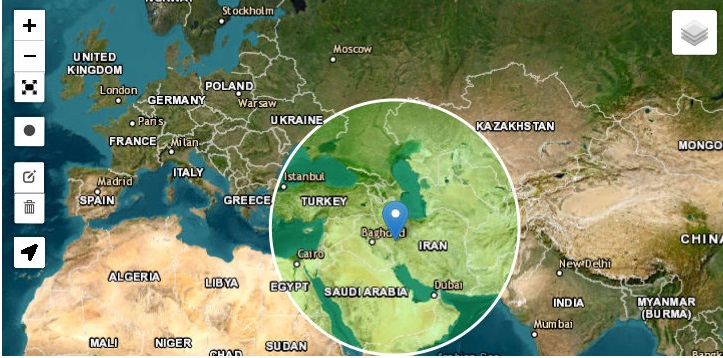
Hence a ballistic missile arsenal with maximum 2,000 km range, giving Iran a 2,000 km radius “anti-access” zone (see map). IRGC has sea cruise missiles, land attack cruise missiles (LACM), short-range ballistic missiles (SRBM), medium-range ballistic missiles (MRBM), hypersonic missiles (Fattah-1) and hypersonic glide vehicle (HGV; Fattah-2); and soon, one ICBM model, Qaʾim-105, with 10,000 km range. The ICBM is only a deterrent should Donald Trump seek to carry out his threats against Iran, which includes his open threat to commit war crimes against Iranians. IRGC will have the ability to destroy Washington, D.C. or New York City should Trump attack Iran. I suspect Qaʾim-105 will be in service before the next presidential inauguration (20 January 2025).
Locked and Loaded
The way it works. IRGC Aerospace has built thousands of missiles. Most models of missiles use solid fuel propellants, i.e., they can be fueled and stored; whereas, liquid fuel propelled missiles must be fueled before use; this takes time. The missiles are stored in numerous underground missile cities scattered throughout Iran, including under the Zagros and Alborz mountain ranges, which make them difficult for the US and Israel to destroy. The missiles are launched from mobile launchers, not fixed underground silos, which make them harder to locate and destroy.
Conclusion
In sum, Iran has a vast array of missiles reflecting different operational ranges and payloads. The missiles are stored in dispersed underground facilities. Most missiles are fueled and ready for launch from mobile launchers. The speeds of missiles are multiples of the speed of sound, and reach targets in under ten minutes. Hypersonic missiles, defined as speeds higher than Mach 5, can reach Tel Aviv, Haifa, Dimona, and every U.S. base in the Persian Gulf in 3 to 6 minutes. Given the weaknesses of U.S. and Israeli air defenses, Iran now has powerful deterrence against American adventurism.
I have argued elsewhere that Tehran engaged in “strategic patience” for the past two decades until IRGC Aerospace had developed, tested, and manufactured in massive quantities its array of SRBM, MRBM, LACM, hypersonic missiles, sea cruise missiles, and air and sea drones. Netanyahu pushed his luck by striking the Iranian diplomatic facility in Damascus on 1 April 2024. IRGC was ready to shift gears from strategic patience to active deterrence. Tel Aviv discovered the meaning of FAFO. A new strategic equation has been set in the Middle East.
[1] See, e.g., Dexter Filkins, “The Shadow Commander,” The New Yorker (23 September 2013); Daniel Mehochko (SSA, FBI), Iran’s Post-9/11 Grand Bargain: Missed Opportunity for Strategic Rapprochement Between Iran and the United States (Ft. Leavenworth: US Army Command and General Staff College, 2013), 53; Barbara Slavin, Bitter Friends, Bosom Enemies (New York: St. Martins, 2009), 190, 194–95.
[2] Senate confirmation hearings for Condi Rice (S. Hrg. 109–151, 18–19 January 2005), 149 (emphasis added).
 Perspectives
You must be logged in to post a comment.