Trump has re-imposed “maximum pressure” sanctions on Iran and Ayatollah Khamenei closed the JCPOA file. Where does Iran go from here? The U.S. oil embargo on Japan and Pearl Harbor suggest military scenarios.

Threats and Pressures
Donald Trump’s demands of Iran expressed in his 4 February 2025 National Security Presidential Memorandum (NSPM/2) are maximalist. It goes beyond JCPOA and seeks curtailment of Iranian ballistic missiles (ICBM, IRBM/MRBM, SRBM). No nuclear weapons, no ballistic missiles, and no conventional weapons? The demands are unacceptable to Tehran.
Section 1. Policy. It is the policy of the United States that Iran be denied a nuclear weapon and intercontinental ballistic missiles; that Iran’s network and campaign of regional aggression be neutralized; that the IRGC and its surrogates be disrupted, degraded, or denied access to the resources that sustain their destabilizing activities; and to counter Iran’s aggressive development of missiles and other asymmetric and conventional weapons capabilities.
Section 1, NSPM/2, 4 Feb 2025 (emphasis added).
An unverified report dated 9 Feb 2025 claimed that Trump sent a direct message to Tehran that the government of Iran ignored as they did not wish to “dignify it with a response.” Threats were issued by Trump in his interview with the New York Post (below). The likelihood of military action is greater than the likelihood of a diplomatic settlement. Who will strike first?

Pearl Harbor
The U.S., purporting “neutrality” through laws enacted in 1935, 1937, and 1939, engaged in trade with warring powers through the “Lend-Lease Act.” It supplied the Soviet Union and Great Britain with raw materials and military equipment. Meanwhile, the U.S. traded with imperial Japan, but FDR, increasingly enamored of China, engaged in economic warfare against Japan. A series of measures enacted by FDR from 1939 to 1941 increased economic pressures on Japan, strangling it of access to oil, steel, scrap iron, lubricants, machine parts, and other material. Finally, the U.S. froze all Japanese assets in the U.S., ending commerce between the two nations. Japan’s position was untenable. The Japanese Foreign Minister wrote,
The U.S. knew its economic measures would compel Japan to strike. This was the plan: force Japan to fire the first shot, allowing the U.S. to whine that it was the innocent victim of Japanese belligerence. This is the narrative that is popular in the U.S.: Poor America. We were just minding our own business when the “sneaky yellow bastards attacked us.”
Iran
Iran cannot allow for “maximum pressure” sanctions to continue indefinitely. Tehran has stated that “if we cannot sell oil, nobody can sell oil.” Iran and Russia face the same predicament: Trump has indicated he will target Russian oil sales.
Pearl Harbor was a major gamble for the Japanese Navy—an expeditionary force that traveled thousands of miles to neutralize the U.S. Navy. However, Iran has “homefield advantage,” and the U.S. Navy is a faux expeditionary force, i.e., USN lacks the critical vessels required of an expeditionary force. USN must rely on “friendly” ports for oiling, supplies, and for re-loading of VLS silos (e.g., Bahrain). The U.S. Navy is “exploring” how to re-load at sea. If VLS silos are empty, ships are defenseless against incoming missiles and drones.
Friendly ports can be neutralized, leaving U.S. Navy vessels vulnerable. The failure of “Operation Prosperity Guardian,” when USN was humiliated by Ansarallah, is an example of a navy figuratively out of its depth. U.S. bases in non-NATO countries (Iraq, Syria, Kuwait, KSA, UAE) can be neutralized by Iranian missiles and drones. U.S. integrated air defense systems are porous. Iran demonstrated this with True Promise I and II.
Scenario
Iran can secure a peace treaty that cancels U.S.-led economic warfare measures if it defeats Israel and the U.S. in war. I doubt Iran will receive sanctions relief absent defeat of U.S. and Israel. A war scenario may follow the sequence below.
1. Iran tests its inter-continental ballistic missiles (ICBM). The program has been underway since Trump’s first term; its status is unknown. Iranian ICBMs capable of striking the east coast of the U.S.—NYC, DC, Boston, Philadelphia, Baltimore, Atlanta, Miami, etc.—will chill Trump’s enthusiasm for launching nuclear or non-nuclear missile strikes on Iranian soil.
2. Iran launches Operation True Promise III. This is Iran’s retaliation for Israel’s failed 26 Oct 2024 strike. Iran will eschew the restraint it had shown in TPI and TPII, and strike a mix of civilian (i.e., oil platforms, oil refineries, ports, airports, power plants, etc.), and military targets that will leave Israel reeling. The “usual suspects” that control U.S. government, foreign policy, and the media will scream for U.S. intervention. If the U.S. succumbs to Israeli pressure, every U.S. land- or sea-based asset is now inside of Iran’s “Ballistic Missile Ring of Fire.” They will be neutralized.
3. Iran exits NPT and tests a nuclear warhead. It is imperative that the nuclear bomb test follow TPIII, otherwise, Israel will reason that a nuclear strike is incoming and launch nuclear missiles. Now that Israel and U.S. know that Iran can attack both countries with nuclear weapons, future exchanges between the U.S.-Israel bloc and Iran will be limited to conventional weapons. If Netanyahu is stupid enough to launch a nuclear warhead at Iran, he can kiss Tel Aviv and Haifa goodbye (Israel is a “two bomb country”: one for Tel Aviv and one for Haifa).
Conclusion
Iran and Russia have a strategic partnership. Iran will benefit from Russian support, which I suspect will not be discreet in light of the NATO-led proxy war on Russia. It behooves Putin to let the Islamic World know that he helped defeat the U.S. and Israel.
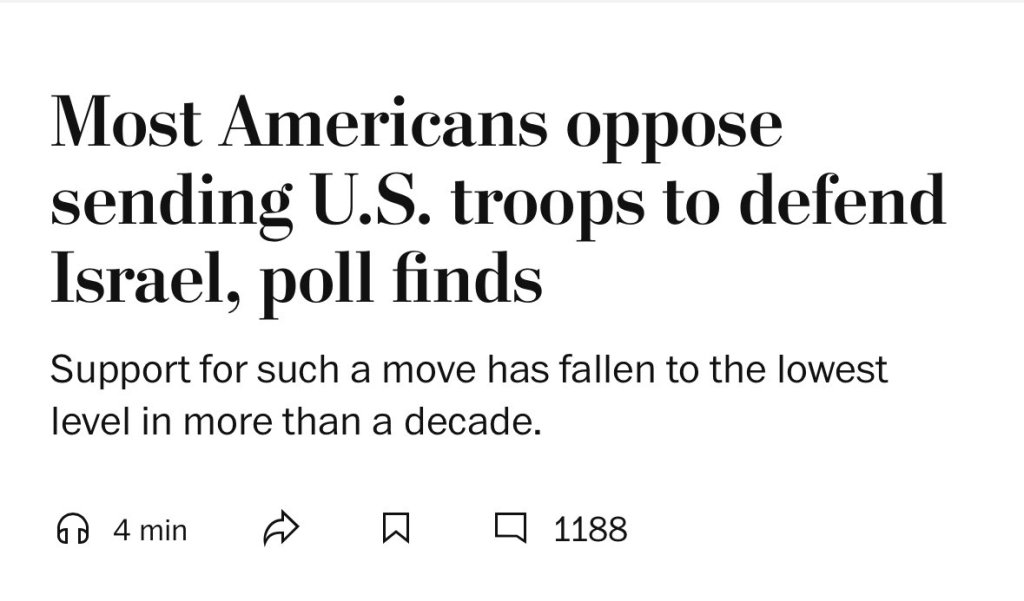
Israel will lose the war: it’s a tiny country with military assets and population concentrated in a few areas. IRGC can pulverize the country with barrages of ballistic missile strikes. Moreover, given the antipathy towards Israel among American conservatives (i.e., apart from Evangelicals who remain devoted to Israel), it will be difficult for AIPAC to rally support for Israel. Americans have made it clear that “We will not die for Israel.” Israel will be forced to sue for peace.

 Perspectives
You must be logged in to post a comment.