Iran now treats hostile rhetoric as casus belli—preemption is on the table. As nuclear and missile programs recover, could Tehran launch blitz to shatter Israel’s OODA loop and paralyze its inner rings before Tel Aviv can move? First mover seizes initiative…
Introduction
On 6 Jan 26, Iran’s Defense Council issued a notification that “Iran does not limit itself to reacting only after an attack, and considers tangible signs of threat as part of its security equation.” The Council emphasized that this includes “hostile rhetoric.” Resumption of the Iran-Israel War is inevitable. Who shoots first?
War may not be avoided but is deferred to the advantage of others
—Machiavelli, The Prince, ch. III—
Preemptive War: strike first to gain initiative to counter an imminent threat. “When a state preempts, it has made a choice between the option of receiving the first blow or striking first.” (Colin Gray, see bibliography). Science of Military Strategy, by China’s PLA, states that it will react not just to military strikes, but also to political or strategic threats; switching military posture from strategic defense to strategic offense. The textbook preemptive war case is Israel’s “Six-Day War” (June ’67) due to the blockade of the Tiran Straits (casus belli), mobilization of Egyptian, Syrian, and Jordanian armies, and hostile rhetoric. In contrast, a Preventive War is to counter a distant and hazy threat (e.g., Bush’s Iraq War in 2003; Israel’s 13 June 2025 war on Iran).
Given the daily diarrhea of “hostile rhetoric” from American and Israeli officials and media commentators; manifest arrogance, nastiness, lawlessness, and addiction to violence of U.S. & Israel—four counts of piracy (as of 7 Jan 26), bombings, murders, and kidnappings in Venezuela; assassinations and/or bombings in Iraq, Iran, Lebanon, Nigeria, Somalia, Syria, and Yemen—Tehran is justifiably alarmed.
Do not make light of any enemy / No matter how unworthy he may be
—Ferdowsi’s Shahnamah—
I. Logic of Preemptive War
Iran and Israel have a ceasefire (24 June 25). Given Israel’s custom of violating ceasefires— “you cease, we fire”—resumption of hostilities is inevitable. The sole issue for Tehran is whether they shoot first or Tel Aviv shoots first. Iran and Israel learned lessons from the Twelve-Day War. Both needed time to fix deficiencies before the bell sounds and they are back in the ring.
I. (a): Point of Culmination
Contrary to Trump’s bloviations, Iran’s (disclosed) nuclear sites were not “obliterated.” 440kg of 60% HEU survive. It is all but certain that part of this uranium stockpile is being enriched to 90% HEU at an undisclosed site. Missile bases are being hardened, and holes in the air defense network are being plugged. This surely concerns Israel: von Clausewitz (ch. 22): “The question therefore is one of superiority. Every reduction [or increase] in strength on one side can be considered as an increase [or decrease] on the other.”
Iran may reach a “use it or lose it” point. Israel will never allow Iran to acquire supremacy in offense: “the most potent military assets of some polities may be so vulnerable to attack that if they do not strike first, they would not even exist to strike second. Preemption is all about self-defense” (Gray, p. 9). Tehran may reason that given their failures in June, U.S. and Israel will strike nuclear facilities—possibly even missile bases—with tactical nuclear weapons. Carl von Clausewitz (chaps. 5 and 8):
the point of culmination will necessarily be reached when the defender must make up his mind and act, when the advantages of waiting have been completely exhausted [and he makes a] sudden powerful transition to the offensive.
—von Clausewitz, On War—
I. (b): Surprise & Resistance
B.H. Liddell Hart does not specifically discuss preemptive war. However, while reflecting on the outcomes of wars—from Marathon to Sedan—he observed that the vanquished entered the conflicts at a psychological disadvantage, i.e., they were surprised, and because of this, their tactics were impaired. Victories fell into two classes (i) “strategy of elastic defense…” or (ii) “strategy of offence, aimed to place oneself in a position ‘upsetting’ to the opponent [surprise], and capped by a tactical defensive: with a sting in the tail” (p. 163). A purpose of strategy “is to diminish the possibility of resistance [opponent’s tactics], and it seeks to fulfil this purpose by exploiting the elements of movement and surprise” (p. 337).
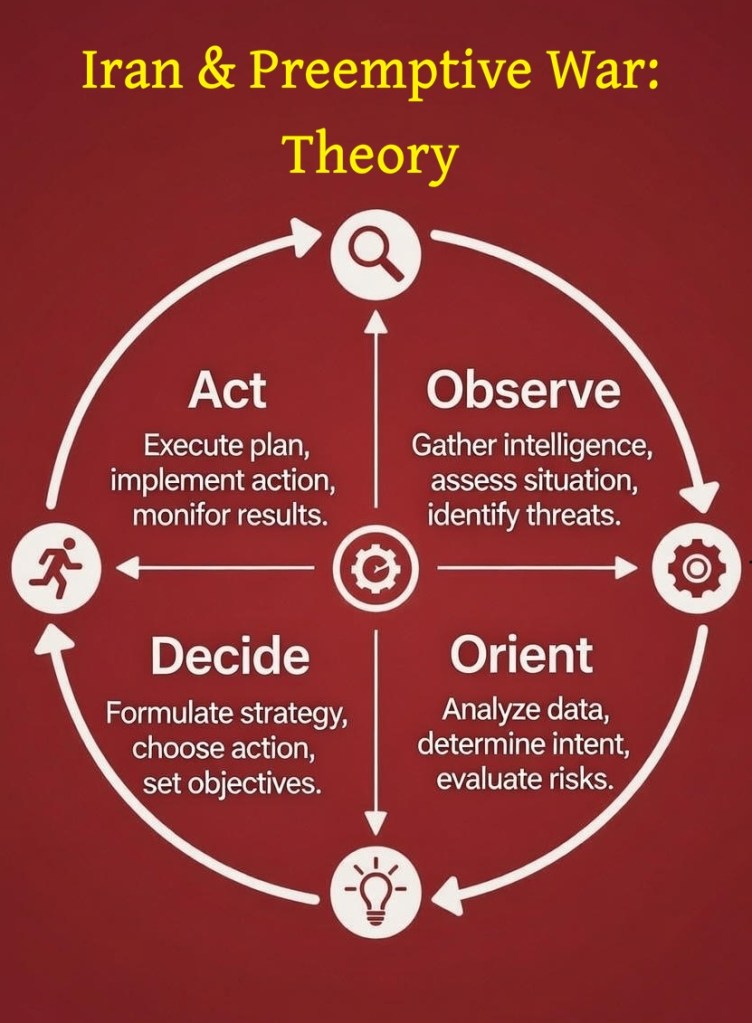
Liddell Hart’s “movement and surprise” is echoed in John Boyd’s “OODA loop” (Observe, Orient, Decide, Act). Victory is advanced by penetrating an opponent’s OODA loop to cause confusion, disorder, and paralysis. Boyd’s OODA relates to John Warden’s targeting theory; this is visualized as five concentric rings: R1 (leadership), R2 (organic essentials), R3 (critical infrastructure), R4 (population), R5 (fielded forces).
Israel targeted Iran’s political-military leaderships (R1) and air defense network (R2), R3 (Shahr-e Rayy oil refinery, Fajr-e Jam gas refinery, Shahran oil depot), and R4 (civilians). It did not confront R5 (Iranian troops). However, Tehran recovered quickly, and by striking the refinery at Haifa, made the price for targeting Iran’s R3 prohibitive. Israel begged for a ceasefire when it became clear its preventive war had failed badly. Iran will not want to find itself in a similar position. The U.S. and Israel will assuredly refuse a ceasefire if Iran fails in its preemptive war.
II. Preemptive War Pros & Cons for Iran
A few thoughts. Points below are not dispositive. There are assuredly more pros and cons to unleashing a preemptive war.
II (a): Cons
(1) Unrest in Iran: Organic protests in Tehran’s bazaar due to currency devaluation commenced eleven days ago, but were hijacked 2-3 days later by radicals encouraged by foreign operators on Telegram; and armed with Molotov cocktails, IEDs, AK-47s, shotguns, etc. This violence, not coincidently, is primarily along the Iraq-Iran border, in dominantly Kurdish regions, where operators and equipment are smuggled in from Iraqi Kurdistan. Kurdish separatists (PJAK) are operating in Ilam Province. Violence is near missile bases in the west and southwest that saw action in June. Today (7 Jan 26), Baluch separatists began terror attacks. Attacks by Kurds and Baluchis expose CIA/Mossad involvement.
State sponsored violence is right out of the CIA/Mossad playbook; for e.g., DB/ANABASIS, plan created by CIA’s Iraq Operations Group in 2002 to de-stabilize Iraq. It was shelved after Congress authorized the Iraq War, but its tenets are being employed in Iran. The U.S.-Israeli goal is to keep Iran on slow boil until they strike.
(2) Iran is a missile-centric nation: Its air force is an embarrassment. But for Iran to swiftly degrade Israeli air defenses, it must be willing to neutralize THAAD radars/batteries, which are intentionally operated by American “human shields.” Tehran has to decide if its willing to kill U.S. troops operating THAAD equipment.
(3) Israel’s Air Force: Iran would have to replicate IDF’s 5 June 1967 actions and remove the bulk of Israel’s air assets before they flee to Cyprus. This is a tall order given that missile launches will be detected, allowing 6-10 minutes warning.
(4) Nuclear backstop: Iran needs nuclear weapons to neutralize Israel’s nuclear threat.
II (a): Pros
Paradoxically, the current organic protests and western-fueled riots and terror attacks by Kurds and Baluchis may compel Iran to act. For nearly five decades, Iran has endured sanctions, threats, saboteurs, agitators, and two western-backed wars (Iran-Iraq and June war) that cost it blood and treasure. The Iranian nation has not been allowed to function and develop like any other nation. Tehran may consider a “strategy of limited aim” (Liddel Hart) necessary to break free of shackles, i.e., a war that yields a negotiated peace treaty, which, inter alia, permanently lifts unilateral U.S. sanctions.
Last word
It is unclear if Iran has fully plugged all the gaping holes in its air defense radar network after the June war, and installed new SAM batteries as unverified sources have claimed (depending on who one asks, China or Russia, or China and Russia, supplied SAM systems). Iran’s generals will have to overcome geography to speedily strike Israel and penetrate the OODA loop. Striking Israel’s R1—military leaders—may have limited utility, for IDF, as Iran’s IRGC and Army (Artesh) did on 13 June, may adapt more quickly than anticipated.
Bibliography
B.H. Liddell Hart, Strategy (New York, 1954)
Carl von Clausewitz, On War, eds. Howard and Paret (Princeton, 1976).
Colin Gray, The Implications of Preemptive and Preventive War Doctrines: A Reconsideration (US Army, Strategic Studies Inst., 2007).
PLA, Science of Military Strategy (English trans., 2013, 2020)
 Perspectives